Environmental Policy - Camden Art Centre

Camden Art Centre has an excellent track record on reducing carbon emissions, and increasing our environmental sustainability remains a key operational goal.

The world is facing a series of linked environmental crises. In October 2022, the UN warned that the world’s governments are not yet on track to keep global heating below 1.5 degrees, and the window for action is rapidly closing. We are already seeing the impacts of existing warming with devastating droughts, storms and floods across the world. Without urgent action from across society, these problems will rapidly escalate.

The art world has an important role to play. Arts organisations – particularly in the Global North – have a disproportionately large impact on the environment, mainly due to a great deal of international travel, arts shipping, and high use of energy and materials. We need to act urgently to reduce these impacts in line with what the science is telling us.

Why is the climate emergency important to our mission?

Camden Art Centre has an excellent track record on reducing carbon emissions, and increasing our environmental sustainability remains a key operational goal. As a societal issue, and one that is important to the staff, artists and communities we work with, addressing the climate emergency is important to our overall mission, ensuring our work remains relevant. We aim to be a beacon of good practice in reducing our carbon emissions, to limit our pollution and waste, save energy and practise recycling. All visitors and staff should feel able to engage with our environmental programme, in the same way they do with our exhibition and learning programmes, and with just as much integrity.

We have an internal ‘Green Team’ with different department representatives who meet regularly to move forwards on actions. We participate in Julie’s Bicycle ‘Creative Green’ environmental certification scheme specifically designed for the creative sector, and were winner of ‘Best Museum and Art Gallery’ in the Creative Green Awards 2017, and were awarded the ‘Carbon Champion’ level of certification from Camden Climate Change Alliance for 2021. We joined Gallery Climate Coalition in 2021 and have Active Member status demonstrating our focus on actions we can take, and we also participate in dialogue through the Plus Tate network.

We welcome all input from visitors and invite members of the public to engage in our policy. Should you have any suggestions or questions regarding our environmental focus at Camden Art Centre, please contact info@camdenartcentre.org.

Our environmental impact

  • We have a target to at least halve our overall carbon emissions by 2030, from a 2019 baseline, and reduce our exhibitions emissions by 50% by 2026. As of 24/25 building audit we are pleased to see a reduction of 50% in our buildings carbon footprint since 2019/2020, marking an extraordinary milestone for Camden art Centre; our exhibitions programme has reduced its carbon footprint by 43% from its 2019/2020 baseline. We continue to try to reduce waste production and energy consumption in real terms for gas, water and electricity.
  • Using Julie’s Bicycle metrics we continue to see a downwards trend in our CO2e tonnes emissions. 2024/25 levels were 54.3 tonnes, compared to 100.8 tonnes in 2019/20, or 136 tonnes taking audience travel into account compared to a total of 196.08 in 2019/20. Total energy consumption has reduced by one third demonstrating steady progress.
  • We have now commenced tracking our exhibitions carbon output utilising the Gallery Climate Coalition toolkit. This resulted in 33.09 tonnes of carbon in 2024/25 and 41.52 in 2025/26 (47.07 including data for an international residency). This is supporting our dialogue as an organisation around our programming decision processes. We have reduced the number of exhibition seasons from four to three per year which also has a positive impact on levels of emissions.
  • Our zero to waste policy saved 19.63 tonnes of Co2 in 2025/26, with a recycling rate of 73%. This is the equivalent to saving 110 trees.
  • Our photovoltaic solar panels on Gallery One roof produced 3328 KWH of electricity in 2025/26, enough to power 30% of our building for one month. The efficiency of panels is deteriorating and this is an area identified for future investment. Since installation they have generated 69.2 MWh and have offset 49.1 tonnes of CO2 emissions, equivalent to the energy required to power 4 stadiums for 1 day and the carbon offset equivalent to 1 Hectare of green lands.
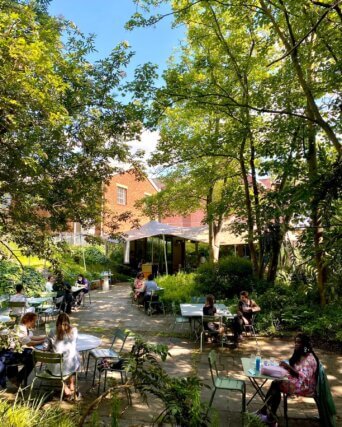
  • We continue to benefit from our rainwater harvesting tanks in our garden to help reduce our water usage and supply water to our garden.
  • We seek to programme work which raises awareness of our environment and the natural world such as The Botanical Mind and Green in the Grooves, courses such as Natural Dyes, and to recycle as much material as possible used in the fabrication of our exhibitions.
  • Our learning programmes use the garden as a site of inspiration and activity with our Youth Collective, SEN Schools Programme and Primary School Projects all regularly using the outside spaces for parts of their workshops.
  • Since 2016 we have procured green energy electricity, through a company which generates 100% of its electricity from renewable sources
  • We have made efficiency upgrades to our Building Management System to reduce our energy consumption and prolong the life of mechanical plant work. This includes upgrading building sensors to ensure plant equipment operates ‘on-demand’ for increased efficiency. We have also set up most of our plant to run on timers to match our opening hours to avoid unnecessary wasted energy.
  • We installed electrical meters on our plant (AHUs and humidifiers) controlling our gallery spaces and on our kilns to better measure the energy usage in those particular areas.
  • We expanded LED lighting installation throughout the building.
  • We have created a trail in the garden to help our younger visitors engage with the natural environment.
  • We commissioned a review of mechanical and engineering systems as part of building redevelopment plans, which have identified long term proposals that reduce energy consumption.
  • Continue to strengthen links with Gallery Climate Coalition (GCC), Plus Tate and Camden Climate Change Alliance to align with best practise in the sector. We seek to work strategically with our own ‘green team’ setting and monitoring internal targets and also with other organisations to share data and learning.
  • Continue to analyse the impact of our exhibitions programme through use of GCC Carbon Calculator, with an aim to reduce transportation (unless shared with at least one other UK/EU venue) and increase local production, as well as seeking to review of impact of materials used in production, in order to overall reduce our carbon impact.
  • Increase dialogue with artists, staff, trustees and the public, including wider training and through plans to share the carbon impact of exhibitions with our audiences in a meaningful way. We plan to expand Carbon Literacy training internally (currently 2 staff are certified).
  • We are also looking at opportunities to recruit a trustee with particular knowledge or expertise to support our environmental planning and monitoring, particularly in relation to our building redevelopment plans.
  • Work with horticulturists and garden designers to develop a plan for our green space which supports biodiversity and climate adaptation.
  • Develop our fundraising strategy to support capital building redevelopment plans which improve our environmental performance and green space.
  • Further embed environmental impact reduction into our procurement policies.
  • Review budget and calculation methods towards establishing a Strategic Climate Fund to be spent on measures to accelerate our emissions reductions, and support frontline climate solutions around the world that are making a difference right now.

Gallery Climate Coalition (GCC) is an international community of arts organisations working to reduce our sector’s environmental impacts.

GCC’s primary goal is to facilitate a reduction of the sector’s CO2e emissions by a minimum of 50% by 2030.

Camden Art Centre achieved Active Membership status of the GCC by:

Awards

Active member GCC 22-26