Essay by Will Heinrich
‘Improvisation is informed by passion and conditioned by knowledge’ Cecil Taylor
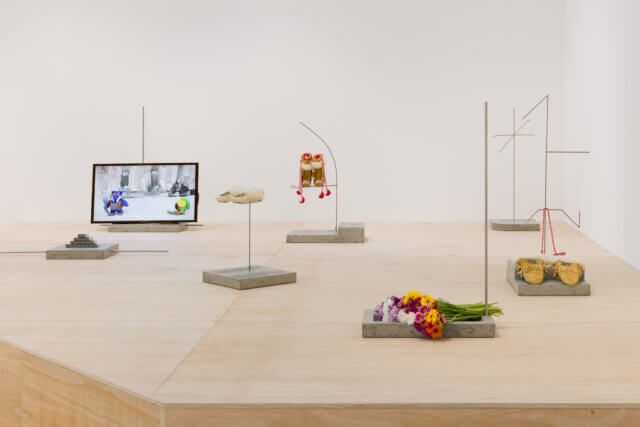
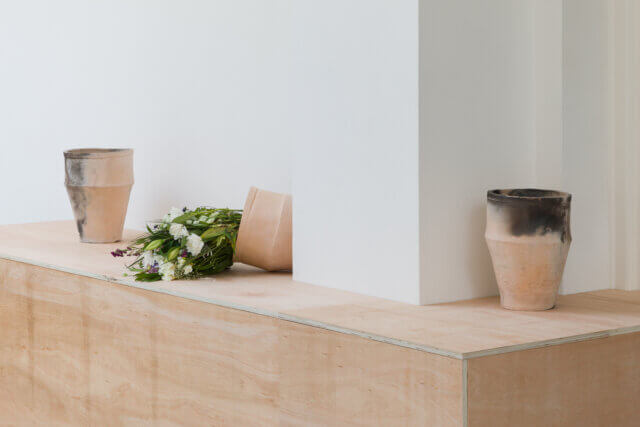
We only had time to grab a single pot, so I put in it what I could. Flint and tinder, fish hooks, string. From my mother came bread and a strip of venison, from my father a coin with a dead king on it. When he was our king, we never liked him, but in a foreign land we might want to remember him. I put in water and thirst, rain and a warm quilt, some residue of woodsmoke around the lip. I quickly knocked down the corners of my room and some twigs that looked like lodgepoles. I added bricks to make the pot heavier and iron nails to prick my fingers when I reached in. My grandmother gave me her dances, or anyway some of them, and while crumpling them to make them fit I shed a few tears on top. She told me my tears would keep them supple. I knew it was a lie meant to console me, but because it came from her I brought it along just the same. When I had crossed the boundary of the village, I leaned into the pot and added a second lie to the first: ‘I don’t need your consolation’, I told my grandmother. ‘I am a man.’ I picked up squash and beans and okra and potato pancakes. The two lies echoed in the pot, as if my grandmother were still speaking. ‘Put a fire in the pot’, I heard her say, ‘and a trap made of green saplings for the salmon to jump into. Do not marry your sons to Canaanite women. Remember my commandments and do them.’ I thought I was fleeing the invaders but when I saw that they were before me, too, I stopped where I was and buried the pot. I planted okra and squash and potatoes and beans and cut a dozen young ash trees for lodgepoles. I married, begot children, ploughed fields, erected temples, and set a large stone at the boundary of my village. In the summer we went fishing and hunted. In the winter we studied the prophets by firelight. One morning, a party of invaders came over the ridge. There were more of us than of them, but we were taken by surprise and many people were killed before we drove them off. I took one of my grandmother’s dances and buried it with my children. I don’t know if that was right. We had more children. One morning, another party of invaders came over the ridge and this time they killed me. I breathed in, somehow, still, with one eye missing and a hole in my throat, lying in the beanfield, and breathed out again somewhere else.
‘Remember’, my grandmother told me, taking a few steps and gesturing with her fingers, ‘it goes like this’, but when I returned to the village this time, as a baby girl, I had forgotten. My aunt taught me pottery and singing, though the songs she knew were garbled and fragmentary, and when I was old enough she showed me the pot beneath the cookfire where the patterns were kept. It was a misty day, and without opening the pot she took me outside and pointed to a droplet of water on the end of a pine needle. ‘Notice’, she said, ‘that everything is reflected. The sky is contained in this droplet of water, the forest, the country, the oceans and all their fish, the invaders and you and I, and our tent, as well as the pot beneath the cookfire and everything in it.’ The pot beneath the cookfire, she explained, was only a pot. But it, too, was a droplet of water. ‘If I made another pot in the same shape’, I asked, ‘would that pot, too, be a droplet of water?’ ‘Everything is a droplet of water’, said my aunt. ‘What you mean to say is, “Would I have eyes to see it?”’ One morning, a party of invaders came over the ridge. I only had time to grab a single pot, so I put in it what I could. Necklaces, needles, snow glasses, red ochre, a handful of beads. I wrapped my sister’s last words around my husband’s braid. Traveling west I was married again. Because my husband and sons had kidnaped me, I came to feel confused about the meaning of love. Every day while drawing water I considered jumping in the well, but I was afraid. One morning, I smashed the pot and scattered its contents. But I let my daughter know where I had buried the shards, and after my husband got drunk and murdered us both I came back as a man. I knocked over the cross they had placed on my grave and for this and other reasons they hanged me. It happened before I could take a breath; when I screamed, it was as an infant again. When I came of age and wanted to marry again I showed the girl I loved my spear, my cross and an iron knife. One night, much later, she unwrapped a red cloth and showed me her handful of pottery shards. It was misty in the cabin with the shutters open, and the shards glittered in the firelight. Strange patterns reflected from their shiny reddish glaze and moved across the ceiling beams. ‘Notice’, she said, ‘that everything is forgotten. This clay was dug beside a river that has emptied itself into the ocean a thousand times. It was shaped by hands that grew old and were buried and grew up again as corn and squash and potatoes and beans, to be eaten and shat and eaten again, to be turned to flesh that would die again, and it was fired in a fire that left no traces.’ She picked up the smallest shard. ‘But the form reverberates.’ She traced her finger along the glaze. ‘However small you break it’, she said, ‘the shard retains a curve. The curve implies a shape, the shape implies a posture for the person that made it, the posture implies an attitude, and an attitude implies a culture. A culture needs a people, and the meaning of a people is to live.’ I lay awake that night while my wife was asleep and tried to follow the ripples of her thought. The Earth revolves in space, space extends forever, and the infinite stars are fixed. If I crushed the shard into powder and mixed it into my garden, would my squash and okra grow any different? The question wasn’t whether the whole is contained in its parts, but whether any one part can ever see it. A teardrop caught in my eyelashes, and through it the smoky room seemed to fracture and glitter like a jewel. In the morning a party of invaders came over the ridge.
They camped in my field, slaughtered my animals, took my wife. I fought with them until I was left bleeding in the dirt. In my grief and humiliation I kept my droplets to myself. Every day I stared into the well, and I neither married again nor wept nor sired children. But when at last I died and was buried in the garden, I rotted and grew up again just the same. I was eaten and shat and eaten again, to be turned back to flesh and die again. ‘I only had time to grab a single pot’, my grandmother told me, taking a few steps and gesturing with her fingers, ‘but there is only one pot. An alphabet, a syllabary, a few prepositions. Confusion, rage, hunger, iron arrowheads and sexual desire. As a young woman I wanted to show the warriors what I had, so I dug up the pot and spread its contents on a blanket in the sun. Necklaces, needles, tin cups, ivory pipes and shiny beads cut from clam shells. Gold coins, newspapers, tiny diamonds, scraps of parchment inscribed with holy words. Pomegranate seeds. Combs and brushes. The warriors would stop for a moment as they walked past, or maybe just turn their heads. But one squatted down to look with me, and after a long while he opened his ribs and pried out his possessions to show me, too. He remembered songs and fairy tales, and holding his mother’s hand in the rain, and his own grandmother painting ochre on his cheeks. He was brave and impatient, sometimes kind and sometimes cruel, handsome except for his sunken, pockmarked cheeks.
We combined our stores and wrapped them up again, and when the camp moved we carried them with us. I suckled six babies and buried three. I had fifteen grandchildren and fifty great-grandchildren, and they had hundreds more. One of my beads is at the bottom of the ocean and another reached the islands on the other side. Don’t ask me what I kept or lost. Some of my children had their lips sewn shut and some were taken away. Some of my sons were killed in battle and some were beaten and lashed and some were enslaved and some were victorious and many of my daughters were raped. Some of my grandchildren choose to remember and some choose to forget, but also no one has a choice about anything. Some of my grandchildren murdered their cousins and asked for my forgiveness. I told them I forgave them, but I knew it was a lie. I don’t know if that was right. Some of what they said was new and some of it was old. Some of what they remember is true and some of it false. If you obey the commandments and keep them, we are told, we will be given health and prosperity, but then we’re all cut down just the same.’ She pulled aside her shirt, and one wrinkled breast, and with her fingertip traced the line of her sternum. ‘But notice’, she told me, ‘that life has a curve. A curve implies a shape, and a shape must have a limit, as I said. But a limit implies a choice, and a choice carries meaning, which carries intention. And intention, you must remember, comes from faith, which is limitless.’
Will Heinrich is a novelist and critic based in New York.
akâmi– at Camden Art Centre is generously supported by Friends of New Curators with the support of:
The Bill Morneau and Nancy McCain Foundation
Elisa Nuyten
Jay Smith
and the Council for Canadian American Relations
New Curators offers aspiring curators from lower socioeconomic backgrounds a paid, year-long intensive curatorial training from its base at the South London Gallery. This unique programme is designed to equip the next generation of curators with the knowledge, practical skills, networks, and confidence needed to thrive in the contemporary art world and transform it from within.
The programme comprises academic seminars, skills training sessions, extensive networking opportunities, coaching and mentorship, and practical experience working collaboratively on a major exhibition.
akâmi- is curated by the 2024–5 New Curators fellows: Nailah Reine Barnes (USA), Kaitlyn Carril (USA), Mayara Carvalho (Brazil), Danni Cheng (Taiwan/Turkey), Alisha O’Brien Coker (UK), Jasmine Lee (Bermuda), Issra Marie Martin (Philippines/ Canada), Tam Nguyen (Vietnam), Jagoda Witkowska (Poland), Satyam Yadav (India) and Ugbad Yussuf (UK).
Duane Linklater (Omaskêko Ininiwak, born 1976) lives and works in Nbisiing Anishinaabe Aki, or North Bay, Ontario. He attended the Milton Avery Graduate School of Arts at Bard College, completing his Master of Fine Arts in Film and Video. Linklater’s practice is concerned with the exploration of the physical and theoretical structures of the museum in relation to the current and historical conditions of Indigenous peoples, their objects and forms. These explorations are articulated in a myriad of forms, including painting, sculpture, textiles, film, installation and textbased works. Collaboration is an essential component of his work, having widely produced work with Tanya Lukin Linklater, Layli Long Soldier and many of his family members. In 2013, Linklater won the prestigious Sobey Art Award, Canada’s most prominent prize for contemporary artists under 40. This will be the first time he has exhibited in the UK since his inclusion in the Liverpool Biennial in 2018. Following his exhibition at Camden Art Centre, Linklater will have exhibitions at Dia Chelsea and The Vienna Secession.
Tanya Lukin Linklater’s artistic practice spans video, sculpture, and dance in museums. Sensation, embodied inquiry, scores, rehearsal, and being in relation (to ancestral belongings and weather) structure her work. Through citation of Indigenous peoples’ lived experience and cultural work, she honours practices and lineages that exceed dominant ideas of who we are. Her recent exhibitions include Aichi Triennale, Japan; Gwangju Biennale, South Korea; New Museum Triennial, New York; San Francisco Museum of Modern Art; and Toronto Biennial of Art. Her solo exhibition, Inner blades of grass (soft) inner blades of grass (cured) inner blades of grass (bruised by weather), including works from the last ten years and new commissions, was presented by the Wexner Center for the Arts (Ohio) in 2024. In 2025 as Grey Plumes she will present new work with Duane Linklater at Camden Art Centre, London, UK organised by New Curators. She will also present a new performance at Dia Chelsea, New York. Her recent publications include poetry and art writing on Sonya Kelliher- Combs, Taqralik Partridge, and Ruth Cuthand. She recently completed her Ph.D. in Cultural Studies at Queen’s University, and she is a faculty mentor for the Institute of American Indian Arts’ MFA in Studio Arts. Her Sugpiaq homelands are in the Kodiak archipelago of Alaska.
Ned Blackhawk, The Rediscovery of America (New Haven: Yale University Press, 2023)
Christopher Bracken, The Potlatch Papers: A Colonial Case History (Chicago: University of Chicago Press, 1997)
Dan Charnas, Dilla Time: The Life and Afterlife of J Dilla, the Hip-Hop Producer Who Reinvented Rhythm (New York: FSG, 2022)
Marcus Chown, A Crack in Everything (London: Head of Zeus, 2024)
Philip J. Deloria, Becoming Mary Sully: Toward an American Indian Abstract (Seattle: University of Washington Press, 2019)
Natalie Diaz, When My Brother Was an Aztec (Port Townsend, WA: Copper Canyon Press, 2012)
Zora Neale Hurston, Barracoon: The Story of the Last ‘Black Cargo’ (New York: Amistad Press, 2018)
Ekkehard Jost, Free Jazz (New York: Hachette Books, 1975)
Scott Richard Lyons, X-Marks: Native Signatures of Assent (Minneapolis: University of Minnesota Press, 2010)
Tommy Orange, There There
(New York: Alfred A. Knopf, 2018)
William and Jim Reid, Never Understood: The Jesus and Mary Chain (London: White Rabbit Books, 2024)
Layli Long Soldier, Whereas
(Minneapolis: Graywolf Press, 2017)
Truth and Reconciliation Commission of Canada – Honouring the Truth, Reconciling for the Future: Summary of the Final Report of the Truth and Reconciliation Commission of Canada (Ottawa: Truth and Reconciliation Commission of Canada, 2015)
Val Wilmer and Richard Williams, As Serious As Your Life: Black Music and the Free Jazz Revolution, 1957–1977 (London: Serpent’s Tail, 2018)
Anysia Kym, Test Your Patience, Track 2 on Truest (10k, 2024)
Bell Witch, Mirror Reaper (Profound Lore, 2017)
Boldy James
Burial
Cecil Taylor, Solo Garden (Hat Hut, 1981)
Cindy Lee, Diamond Jubilee (Superior Viaduct, 2024)
Destroyer, Dan’s Boogie (Merge Records, 2025)
Don Cherry, Mu, First Part and Second Part (BYG Records, 1969 and 1970)
Haruomi Hosono, Hosono House (Stones Throw Records, 1973)
Jeff Parker, Mondays at the Enfield Tennis Academy (Eremite, 2022)
Julius Eastman
L.A. Witch, Icicle, Track 1 on DOGGOD (Suicide Squeeze Records, 2025)
Mandy, Indiana, I’ve Seen a Way (Fire Talk, 2023)
My Bloody Valentine, You Made Me Realise (Creation, 1988)
Pharoah Sanders, Pharoah (India Navigation, 1977)
Sault
Strength NIA, Northern Ireland Yes, Track 4 on Northern Ireland Yes (2018)
Westside Gunn, HEELS HAVE EYES (Griselda Records, 2025)
Whatever the Weather, 0°C, Track 2 on Whatever The Weather (Ghostly International, 2022)
Willie Thrasher, Wolves Don’t Live by the Rules, Track 4 on Spirit Child (Light in the Attic, 2015)
Chantal Akerman
Alanis Obamsawin, Christmas at Moose Factory (Canada, 1971), film
Charles Burnett, Killer of Sheep (United States, 1978), film
Mati Diop, Dahomey (France, 2024), film
Tony Gilroy, Andor: Season 2 (United States, 2025), television
Tasha Hubbard, Singing Back the Buffalo (Canada, 2024), film
Jim Jarmusch, Ghost Dog: The Way of the Samurai (United States, 1999), film
Abbas Kiarostami, Close-Up (Iran, 1990), film
Chris Marker, La Jetée (France, 1962), film
Steve McQueen, Deadpan (United Kingdom, 1997), film
Steve McQueen, Hunger (Ireland, 2008), film
Steve McQueen, Lovers Rock (United Kingdom, 2020), film
Jean-Pierre Melville, Le Samouraï (France, 1967), film
Jake Meginsky & Neil Cloaca Young, Milford Graves Full Mantis (United States, 2018), film
Scott Momaday, The Man Made of Words (USA, 1977), recording
Bob Rodgers, The Fiddlers of James Bay (Canada, 1980), film
Agnes Varda, Vagabond (France, 1985), film