Essay by Yasmina Price
‘I’m interested in the socio-cultural construct of masculinity because when there is a societal standard of what masculinity is, that in itself invites a certain level of performance.’ Karimah Ashadu
A body is a machine, a map, a muse – and muscle.
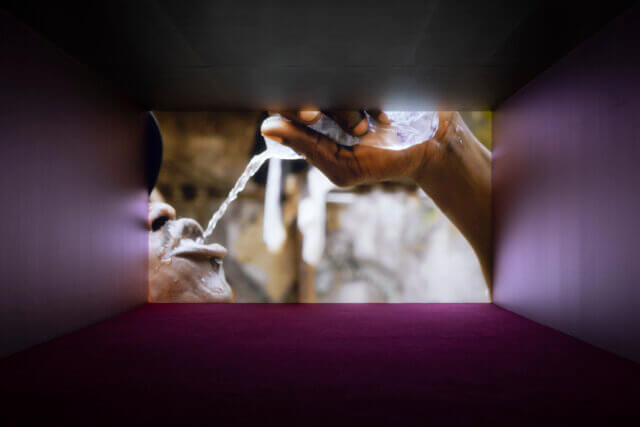
Tensed and coiled within a claustrophobic system, the Black colonial subject dreams muscular dreams, primed for the leap into a liberated self-reconstitution. MUSCLE grafts onto this matter, innervating Karimah Ashadu’s ongoing study of corporeality, masculinity, patriarchy and sovereignty in her new multisensorial survey of Lagos bodybuilders. As the central moving-image installation in Tendered, it repeats and remaps the coordinates of labour and economy carried across her polyvalent practice. Through a choreography and cartography of bodies harnessing their malleability, MUSCLE chronicles the transformational fluidity of machinic improvement, fusing embodiment and engineering in a work that feels at once viscerally material and sinuously virtual.
A body is a visual spectacle, a gendered signifier, a racial codification – an ideological artefact shaped by colonialism, nationalism and capitalism.
The weightlifting subjects of MUSCLE strive towards self-directed authority over their bodies, and by extension, their socioeconomic standing in a gendered hierarchy. The social and economic landscape of masculinity that has its corollary in the body, here channelled, works towards strengthening representational and reputational currency. A conceptual convergence of embodiment and performativity, their bodily labour bridges constraint and clearance, their physiques are at once weapon and shield, they are hardened yet unguarded. Ashadu approaches the musclemen with an observational openness that allows for the coexistence of contradiction.
A contraction is also a release; the mechanism of rupture is also that of regulation.
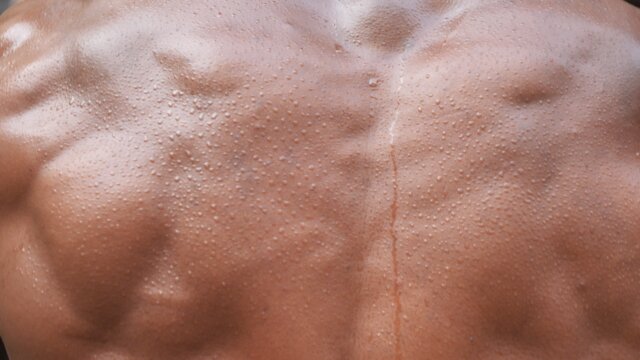
Formally joining together inner subjectivity and external superficiality, the camera’s slippery scan of skin and muscles is paired with a penetrating narrative voiceover by the men. What is at stake links the physical and psychic. They reshape their identities as they reshape their bodies, cultivating a new subjectivity on the assurance that a well-muscled physique will stave off the danger of being considered a ‘nobody’, or worse, not being perceived at all. As we learn from the voiceover, they are indeed looking for attention that brings with it popularity, honour and respect. Their hyperbolic exhibitionism points to bodybuilding as a form of hypervisuality and self-spectacularisation. The camera enters the scene in accordance with the terms that have already been set: look, linger, examine, admire. MUSCLE winds through a makeshift outdoor gym, making the collective ritual of their workouts a kind of open theatre, a porous performance on a public stage. As the bodybuilders are mostly filmed in close-up from bare chest up, save the occasional hat, they almost appear naked, in an unveiled display of exalted manhood.
While there is an unquestionably erotic dimension to the work, Ashadu deftly displaces it from the optic to the sonic. The voiceover narration communicates the desire, fantasy and self-pleasure experienced by the bodybuilders. Even as close-up shots stay close to skin and sweat, their carnal quality is restrained in comparison to the sounds of grunting, exhaling and groaning, mixed in with the clinking of weights, an amplified chorus of exertion that plays on the ambiguity of its origin. Allied with a quality of wayward sensuality, the ensemble of laboured breath slips between registering as a sonic expression of swaggering virility and something more fragile. Their hiccupping breathing pattern suggests moments of vulnerability and unsteadiness. The immateriality of the soundscape does not only create a contrast with the materiality of hardened muscle. A kind of alchemy is produced, unsettling the certainty of solidity. Are their muscles truly dense or merely taught, like a balloon, always imperilled by the threat of deflation?
Another sort of porosity exists between the sculptural elements in Ashadu’s exhibition and the subjects of the video. Just as she produced a series of objects for Tendered, so too do the musclemen produce themselves as new, physically refashioned visual subjects,or objects. MUSCLE casts bodybuilding as a self-creative endeavour and aesthetic practice closest in kind to sculpture. Whether applying a pointed chisel to stone or the weight of a barbell to tissue, what results is a new shape. Auto-Pygmalions, the men rewrite their bodies through an effortful muscular self-portraiture. Seen through the arc of Ashadu’s work, their activity maps onto the remoulding of national identities in the wake of Nigeria’s independence from British colonial rule. By means of a corporeal exploration, her latest installation addresses negotiations over autonomy and self-determination – things taken and never given.
Indeed, the Lagos bodybuilders insist on the purposeful choice which leads them to this path of self-possession and bodily mastery. Push-ups, pull-ups, rows and squats are not just a mechanical set of movements but a work of self-driven construction. As made evident in their involuntary intonations of straining as well as the close-ups showing their facial contortions and muscular contractions, gritted teeth and squinted eyes – the task is neither easy nor comfortable.
As one of them claims, ‘the pain is what makes a man’, and not everyone has the endurance nor dedication necessary. As recurs throughout the voiceover, the bodybuilders describe themselves as intimidating, inspiring fear and repelling the danger of attack while working in the professions for which their muscles have made them eligible, as bouncers or bodyguards. Safety is part of the physical and psychic calculus of their brawny gains. What results from their efforts is the ‘freedom’ and ‘confidence’ of being in a body that,as one of them claims, is equivalent to ‘carrying an AK-47’.
Muscularity and masculinity collapse into each other. A big man has big muscles. These hypermanufactured men are remaking themselves, specifically, to be hypermasculine. In bodybuilding, masculinity is not assumed, it must be made, proven and tested. As in much of her preceding work, Ashadu turns over inherited and contested parameters of global masculinity, conjugated with patriarchal hierarchies in Nigeria, which are themselves internally variable, culturally dynamic and historically contingent. What makes up the tissue of the musclemen’s striving brings together a plurality of constructions of masculinity, all at once indigenous, colonial, local and global. The voiceover disclosures suggest that their bodies are meant to speak strength, courage and firmness in body and mind; convey endurance, aggression, confidence, decisiveness, virility; make a claim on being authoritative and unemotional; and express the ability to protect and dominate. But they do not wish to be entirely known. There is a dimension of opacity to a muscleman – speaking in a fittingly ambivalent tone, another one of them states ‘we don’t know what he can do, we don’t know what he has in mind.’
A body is a mask.
MUSCLE captures the veiled and fictive quality of masculinity. What appears to be the dense solidity of muscle motivates itself through a diaphanous imaginary. While the bodybuilders boldly assert that their physiques command respect and project an image of wealth, one of them confesses that these same bodies conceal the experiences of suffering and lack. Even if their massified self-sculptures suggest affluence and higher social standing, it cannot do much to make it materially true. Ashadu’s intimate contemplation exposes an entire nervous system of contradictions. Bodybuilding can be taken as a resolutely voluntary undertaking which offers an individual physical superiority and psychic revalorisation via a self-driven process of accumulating muscle. Yet as the video reveals, singular advantage and autonomy are not quite present. MUSCLE records a profoundly cooperative and citational pursuit. What we see are not individual triumphs but a series of collective rehearsals, a communal hydraulics of iterative movements amongst almost interchangeable figures. The outdoor gym is a place of true kinship, where the men welcome each other into a mission that relies on mutual knowledge sharing and surrenders claims on singular superiority. Ultimately, the Lagos bodybuilders attempt to attain a single, homogenous ideal. In working to set themselves apart from those they might consider lesser men they reach for an archetypal, undifferentiated template. Their collectivity is knotted, mixing in camaraderie and competition. By striving together to achieve a common template of muscular masculinity, they undertake a performance that requires an audience of which they are also a part. A lesson in this culture of bodily re-creation is that transformation is an interdependent venture. Even with companions, the project of attaining maximised musculature is Sisyphean. There are limits to how much they can augment their physiques. Yet even if age and mortality would not eventually intervene, achieving a maximally built body represents a vexed contradiction. The very mobility and malleability of the body required to accumulate muscle would have to freeze at the point of an unachievable end. While the proximity of the camera in MUSCLE freely pushes at the edges of sight to become tactile and olfactory, the close-ups are also claustrophobic. They formally translate the bodybuilders’ narrowed window of existence as they seek to remake themselves through a vaporous yearning for always more muscle, a seemingly bottomless appetite stoked by the ambivalent capacity for discipline and regulation. Here, self-policing and self-liberation are exhaustingly close
Yasmina Price is a New York–based writer and film programmer completing a PhD at Yale University. She is devoted to visual culture from the African continent and diaspora, anti-colonial cinema and the experimental practices of women artists.
Tendered is curated by Alessandro Rabottini and Leonardo Bigazzi of Fondazione In Between Art Film. Organised within the framework of Unison, a biennial initiative created by Fondazione In Between Art Film to commission and produce moving image-based exhibitions together with international institutions.
MUSCLE is commissioned and produced by Camden Art Centre, Fondazione In Between Art Film, and The Renaissance Society at the University of Chicago, where the exhibition will be presented in autumn 2026.
Supported by The Karimah Ashadu Exhibition Circle and Camden Art Centre Artists’ Circle.
With special thanks to our transport partner TFA London.
Karimah Ashadu (b. London 1985) is a British-born Nigerian artist and film director living and working between Hamburg and Lagos. Ashadu’s practice is concerned with labour, patriarchy and notions of independence pertaining to the socio-economic and socio-cultural context of Nigeria and its diaspora.
Her work has been exhibited and screened at institutions internationally, including the 60th Venice Biennale, where she was awarded the Silver Lion for a Promising Young Participant in the International Exhibition. Her work has been shown at Canal Projects and MoMA PS1, New York; Kunsthalle Bremen; Tate Modern, London; Secession, Vienna; Kunstverein, Hamburg; South London Gallery, London; Museum of Modern Art, New York; Centre d’Art Contemporain Genève; and Trautwein Herleth, Berlin.
Ashadu is the recipient of other awards, including the 2022 Prize of the Böttcherstraße in Bremen and the 2020 ars viva prize. Public collections include MoMA, the Art Institute of Chicago, the City of Geneva Contemporary Art Collection, the Kunsthalle Bremen and the Federal Collection of Contemporary Art, Germany. Fellowships include the Abigail R. Cohen fellowship at the Columbia Institute for Ideas and Imagination, Paris. In 2020, Ashadu established her film production company Golddust by Ashadu, specialising in Artists’ films on black culture and African discourses.
James Baldwin, No Name in the Street (New York: Dial Press, 1972)
Deborah Levy, Things I Don’t Want to Know: On Writing (London: Penguin Books, 2018)
Johny Pitts, Afropean: Notes from Black Europe (London: Penguin UK, 2020)
Max Siollun, The Forgotten Era: Nigeria Before British Rule (London: Pluto Press, 2025)
Max Siollun, What Britain Did to Nigeria: A Short History of Conquest and Rule (London: Hurst, 2021)
Rosa Barba, The Ocean of One’s Pause, MoMA, New York (2025)
Beat the Silence: Sonic Chronicles, M.Bassy Hamburg (2025)
Nan Goldin, This Will Not End Well, Neue Nationalgalerie, Berlin
Perry Henzell, The Harder They Come (Jamaica, 1972), film
Carolyn Lazard, Two-way, Artists Space, New York (2025)
Teboho Mahlatsi, Portrait of a Young Man Drowning (South Africa, 1999), film
Rendezvous Der Traüme- Surrealismus und Deutsche Romantik, Hamburg Kunsthalle, Hamburg (2025)
Franco Russo, Babylon (United Kingdom, 1980), film (2024)
Abderrahmane Sissako, Bamako (Mali; France, 2006), film
Abderrahmane Sissako, Timbuktu (Mauritania; France, 2017), film
Untranquil Now, Hamburg Kunsthalle, Hamburg (2024)
Segun Bucknor, La La La (Hard Version) Pt 1, Track 9 on Who Say I Tire (Distrolux, SL, 2010)
Segun Bucknor, Who Say I Tire, Track 12 on Who Say I Tire (Distrolux, SL, 2010)
The Doors, Riders on the Storm, Track 10 on L.A. Woman (Elektra Entertainment, 1971)
The Funkees, Acid Rock, Track 7 on Dancing Time: The Best of Eastern Nigeria’s Afro Rock Exponents 1973-77 (Soundway Records, 2012)
The Funkees, Akula Owu Onyeara, Track 6 on Dancing Time: The Best of Eastern Nigeria’s Afro Rock Exponents 1973-77 (Soundway Records Ltd, 2012)
The Funkees, Breakthrough, Track 13 on Can’t You Hear Me? (Now-Again Records, 2016)
Ify Jerry Crusade, Everybody Likes Something Good, Track 2 on Nigeria 70 – Lagos Jump (Strut Records, 2008)
Jimi Hendrix, Little Wing, Track 6 on Axis: Bold As Love (Sony Music, 2009)
The Hygrades, Rough Rider, Track 2 on Keep on Moving (The Hygrades, 1971)
Bola Johnson, Lagos Sisi, Track 16 on Man No Die (Distrolux, SL, 2010)
Mavis John, Use My Body, Track 10 on Mr Bongo Record Club, Vol. 1 (Mr Bongo, 2016)
Kings of Leon, Be Somebody, Track 10 on Only By The Night (RCA Records, 2008)
Led Zeppelin, Dazed and Confused – 1990 Remaster, Track 4 on Led Zeppelin (Atlantic Recording, 1969)
Itadi, Watch Your Life, Track 1 on Itadi (Hot Casa Records, 2013)
Jefferson Airplane, Somebody to Love, Track 2 on Surrealistic Pillow (Sony Music, 1967)
The Movers, Give Five or More, Track 1 on The Movers, Vol. 1 – 1970-1976 (Analog Africa No. 35) (Gallo, 2022)
The Rolling Stones, (I Can’t Get No) Satisfaction – Mono, Track 7 on Out of Our Heads (ABKCO Music, 2002)
The Rolling Stones, Wild Horses – 2009 Mix, Track 3 on Sticky Fingers (Remastered) (Universal International, 2009)
The Stone Roses, I Wanna Be Adored – Remastered 2009, Track 1 on The Stone Roses (Silvertone Records Limited, 2009)
Buffalo Springfield, Mr. Soul, Track 1 on Buffalo Springfield Again (Atlantic Recording, 1967)
Ebo Taylor, Love and Death, Track 3 on Love & Death (Strut Records, 2010)