‘Knowledge of the world means dissolving the solidity of the world.’ Italo Calvino
Aqua Fortis
Nat Faulkner’s practice confronts us with an intriguing conundrum: it manages to be all about the photographic even when it features relatively few actual photographs. The artist achieves this by creatively deploying different modes of indexicality to produce a range of marks, images, surfaces, environments and objects, all of which consistently bear on the history and attributes of the medium of photography. In conjuring that history and those attributes, Faulkner also engages specific aspects of alchemy, industrialisation, capitalism and obsolescence, among many other thematic concerns. By these means, Strong water, his latest exhibition, offers a partial journey through modernity itself, at least as it has been filtered through a photographic lens.
That filtering is conjured almost immediately by modifications Faulkner makes to the architecture of Camden Art Centre’s galleries. The first room you enter is bathed in daylight, tinted orange by having been made to pass through pools of liquid iodine placed in the aperture of the building’s skylight. Light, the generative agent for all photography, is thereby made a visible radiation, a thing to be contemplated for its own sake. Liquid iodine is used to disinfect wounds and sterilise surfaces. In the nineteenth century, it was derived from seaweed and applied to silvered copper plates in fumigated form to create a light-sensitive silver salt and thereby enable daguerreotypes to capture an image. As one scholar wrote in 1840: ‘Who could have anticipated that the discovery of a violet-coloured gas in the refuse of kelp would lead to such important results?’1 In Faulkner’s installation, the room is bathed with warm light but, then, so are we, as we pass through it. It’s a physical reminder of our own photosensitivity, of our reliance on a vulnerable skin that reddens in response to an excess of sunlight and needs salving when bruised or burned.
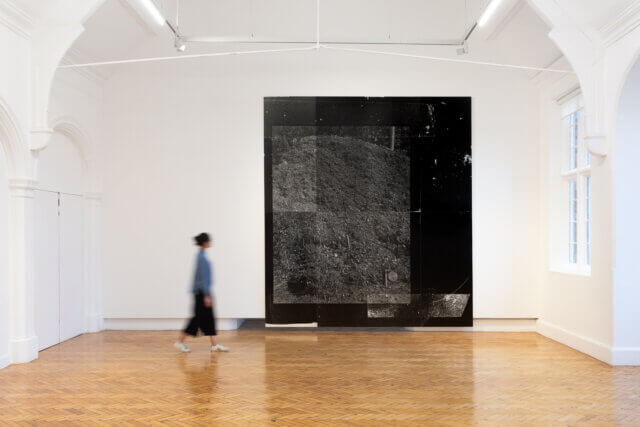
Light has a history. With the advent of the Industrial Revolution, pollution began to darken both sky and foliage, leading to ecological consequences we have yet to adequately address. Faulkner makes this history manifest in a large photograph of a moth, caught by the artist in Wiltshire using a light trap. Known for its close adherence to the laws of natural selection, the peppered moth has evolved from a mostly pale colour to a mostly dark one in response to the blackening of tree bark by industrial emissions. Here, changes in the quality of the environment are remarked by a physical transformation, a warning for us all. Faulkner extends the metaphor into the genre of landscape with another very large photograph, this time an image taken at a metal-recycling factory in Cremona, Italy. It shows a side-view of a mound of semi-processed metal waiting to be further broken down to a powder form, before being melted into ingots for reuse. The photograph on display is a composite of six panels, printed on different days. The artist soon noticed that the prints he made late at night were noticeably darker than the prints he made during the day. This variation in appearance is a consequence of fluctuations in the power grid during any 24-hour period, accentuated into visibility by Faulkner’s long exposure times and his use of artificial light. A power grid acts like a circulatory system. It has a heartbeat, depending on the demands we collectively make on it throughout the day. The variations in the tonal quality of Faulkner’s composite image are a visible trace of this social activity and of its related electrical flow, an accelerated industrial analogue of the evolving moth in the other photograph.
It matters to Faulkner, that this is a photograph of a recycling plant. His own practice mimics aspects of its dynamic: a gathering of things that have been jettisoned, a synthesis and distillation of materials and constituents, and then their alchemical transformation and recirculation. All this enjoys the rhythm of a natural process, as when water vapour condenses, evaporates, precipitates and then falls as rain to begin the cycle again. In this same spirit, Faulkner’s photograph is about recycling, but also of and about itself. To make the print, he placed a negative inside the enlarger that was smaller than the instrument’s glass carrier. This means that, in the print, you can see that matrix for what it is: a piece of gelatin film cut out of a roll of the same material. The light surrounding the negative, together with the tape that holds it in place in the enlarger, as well as the dust and fingerprints on its surface, are printed alongside and over the image, all enlarged to sixty times their original size. Displaying the photograph in this ‘uncropped’ state, rather than allowing it to present itself in a non-space, with no scale, makes apparent that you are viewing an enlargement of a piece of film, floating in a physical space. The tape and dust have become as much part of the image as what was captured on the negative. Outside and inside, past and present, the means of production and the thing produced by them, are all compressed into a single image/object and a singular viewing experience.
‘This building I believe to be the first that was ever yet known to have drawn its own picture.’2 So wrote William Henry Fox Talbot, the inventor of photogenic drawing, in 1839, shortly after announcing his innovation to the public. By granting his own house the agency of authorship, Talbot directly addressed a crucial aspect of his new medium: its harnessing of the indexicality of light-sensitive chemistry to a mechanical apparatus such that the human hand was removed from the act of picture-making. As his French competitor, Louis Daguerre, put it, ‘The DAGUERREOTYPE is not merely an instrument which serves to draw Nature; on the contrary it is a chemical and physical process which gives her the power to reproduce herself.’3 Faulkner extends this proposition to encompass a literal reproduction of parts of his own studio within the confines of Camden Art Centre.
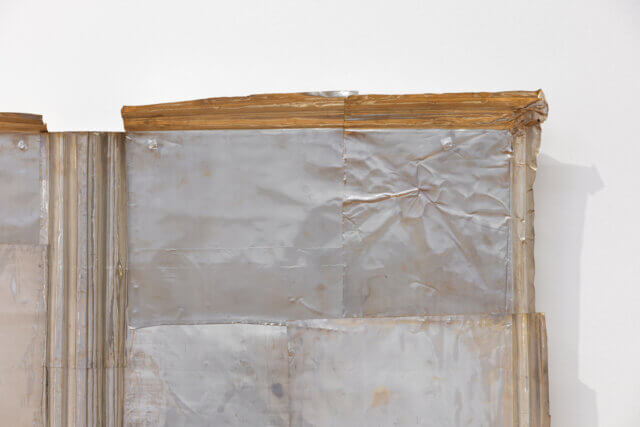
This reproduction begins with a process of rubbing, a way of copying incised and textured surfaces by hand that has ancient roots. The process was called ‘frottage’ when it was adopted by artist Max Ernst in 1925, in his case using paper and a soft pencil in an effort to bring forth unexpected images from rubbings of prosaic matrices such as wooden floors.4Faulkner, in contrast, layered thin sheets of copper over parts of his own studio building and then pressed on and across them until they mimicked the indents and raised patterns of the structure underneath, whether a door frame, a keyhole, a parquet floor or a window pane. These impressed sheets were then submerged in an electroplating bath to coat them in a thin layer of silver. The silver applied by this process of electrolysis was extracted entirely from recycled hospital X-ray film once used by the National Health Service. Once again, this is a material that has a history. That history, the use of silver to document the interior contours of human bodies, now joins an effort to document another interior: the surfaces of a studio space. In both cases, an interior is made exterior, and a private space is rendered public. Having been translated into a form closely aligned with that of a latent daguerreotype plate, patiently awaiting its sensitisation, these strips of silvered metal are attached to the gallery walls of Camden Art Centre. It’s as if Faulkner’s studio has shed its interior like a snake’s skin and left various fragments of epidermis in this other space. The choice of fragments seems arbitrary, and yet, for the artist, they act as key reference points in a 1:1 representation of his place of work. We enter a doppelgänger of that place, a ghostly apparition or double, made all the stranger by its partiality, its reflective surfaces, and its flimsy materiality.
In combining light, chemistry and electricity in an indexical process of reproduction, Faulkner again embeds his work in a long photographic history. Photography was introduced at a moment when light and electricity were both undergoing intensive, and sometimes comparative, study. According to photographer Antoine Claudet, writing in 1843, these ‘sister arts’ were ‘two mysterious agents [that] seem, in fact, to constitute the soul of nature’.5 Then, as now, it was logical to want to try and combine them. In 1844, The Art-Union journal offered a history of the electrotype, an invention, conceived before that of photography, whereby a galvanic battery was used to deposit copper over the indentations of an existing plate, a kind of automatic casting system. As the report exclaimed, ‘Light has been brought under control by the Daguerreotype and the Calotype; and now the electric fluid, that most fearful agent of storm and tempest, is made to perform the most delicate metallic operations with an accuracy and a precision beyond the reach of the most trained and skilful operative.’6 The process could be used to make exact copies of the image deposited on the surface of a daguerreotype, but the basic principles could also be harnessed to add silver to the surface of a machined copper plate, significantly reducing exposure times for photographers using those plates. Claudet himself adopted the work of the English scientist William Grove and his voltaic reproductive process. As Grove put it, instead of a plate being inscribed as ‘drawn by Landseer, and engraved by Cousins,’ it would be ‘drawn by Light, and engraved by Electricity’.7
Channelling photography’s inventors, Faulkner has taken this approach to reproduction a step further, creating a situation whereby his own studio has been allowed to harness electricity and chemistry to generate a relief sculpture of itself – in effect, a three-dimensional self-portrait. That self-portrait is spread across the gallery walls like a distributed memory of that other space. This memorial shimmers with reflected light. But this is once again a light that changes through time, as the silver tarnishes. If you breathe on that silver, it fogs up, like a mirror. If you touch it, you will leave an oily smudge. You can see yourself looking at it, but as a fractured self, broken up by indentations and ridges in the metal. When first installed, these gilded fragments are bright with shiny metallic tones. But as visitors come and go, the colour of the silver changes in response to humidity and the amount of sulphur and other impurities in the air. Unfixed, the appearance of these latent daguerreotype surfaces undergoes a complex transformation. As light hits the film of tarnish on the silver, it splits; some of it reflects off the top surface and some of it reflects from the silver under the tarnish. As a consequence, over the duration of their display, Faulkner’s fragments may shift unevenly from a yellow through a red-brown to a blue tone, and perhaps even to black. The organic and inorganic are caught in a temporal oscillation, another sign of the cyclical change that animates every aspect of this exhibition.
This animation is signalled by the exhibition’s title, Strong water – a reference to Faulkner’s research on the process of creating silver nitrate for photographic film and paper. The primary method for achieving this outcome uses nitric acid, a mineral solution associated with alchemical practices due to its unique ability to dissolve metal. Historically, it symbolised purification, separation and transformation under its Latin name aqua fortis (or ‘strong water’). Water permeates all the facets of Faulkner’s practice, whether it is diluting his photochemistry in rotary print drums or facilitating a silver-plating solution. And it is also there in the metaphor of recycling that permeates the logic of the artist’s choices of subject matter and procedure. As we have noted, all those choices circle back to photography in one way or another. This is what defines Nat Faulkner’s installation: it’s a provocative meditation on the ubiquity of the photographic as a mode of representation – even when it doesn’t seem to be.
References
1 William Buckland to John Franklin, dated 5 September 1840, transcribed as ‘Daguerreotype’, Tasmanian Journal of Natural Science (Hobart, August 1841), 72. For more on the role of kelp in early photography, see Joe Riley, ‘The Pencil of Nature: Tracing intertidal media through the development of early photography’, Tba: Journal of Art, Media, and Visual Culture, 2(1), (2020), 9–21.
2 William Henry Fox Talbot, ‘Some Account of the Art of Photogenic Drawing, or, The Process by Which Natural Objects May Be Made to Delineate Themselves Without the Aid of the Artist’s Pencil’ (1839), from Beaumont Newhall, Photography: Essays & Images (New York: Museum of Modern Art, 1980), 28.
3 Louis Jacques Mandé Daguerre, ‘Daguerreotype’ (1838), in Helmut and Alison Gernsheim, L. J. M. Daguerre: The History of the Diorama and the Daguerreotype (New York: Dover, 1968), 81.
4 Ernst published a collection of these drawings in 1926 titled Histoire Naturelle (Natural History). See https://www.tate.org.uk/art/art-terms/f/frottage (accessed 16 November 2025).
5 [Antoine F. J.] Claudet, ‘The Progress and Present State of the Daguerreotype Art’, Transactions of the Society, Instituted at London, for the Encouragement of Arts, Manufactures, and Commerce, 55:8 (1843), 96.
6 Unknown, ‘Mercantile Value of the Fine Arts: on the multiplication of works of art in metal by voltaic electricity’, The Art-Union (1 December 1844), 348. See also Petra Trnkova, ‘Electrifying Daguerreotypes: On correlations between electricity and photography around 1840’, History of Photography, 45: 2 (2021), 111–27.
7 See Unknown, ‘Important Combination of the Electrotype with the Daguerreotype Process’, The Mechanic’s Magazine, Museum, Register, Journal and Gazette, Vol. XXXV (London: Robertson, July 3, 1841 – December 25, 1841), 223. Grove’s process is also reported in ‘Drawn by Light and Engraved by Electricity’, New Zealand Gazette and Wellington Spectator, Volume III, Issue 158 (July 13, 1842), 2, and N.P. Lerebours, A treatise on photography: containing the latest discoveries and improvements appertaining to the daguerreotype, translated by J. Egerton (London: Longman, Brown, Green & Longmans, 1843), 127–36.
Siobhan Angus, Camera Geologica: An Elemental History of Photography (Durham, NC: Duke University Press, 2024)
Geoffrey Batchen, Negative/Positive: A History of Photography (London: Routledge, 2021)
Jane Bennett, Vibrant Matter: A Political Ecology of Things (Durham, NC: Duke University Press, 2009)
Jorge Luis Borges, Labyrinths (New York: New Directions, 1964)
Italo Calvino, Invisible Cities (San Diego: Harcourt, 1974)
Italo Calvino, Six Memos for the Next Millennium (Cambridge, MA: Harvard University Press, 1988)
Moyra Davey, Index Cards (New York: New Directions / Fitzcarraldo Editions, 2020)
Stephen Jay Gould, Time’s Arrow, Time’s Cycle: Myth and Metaphor in the Discovery of Geological Time (Cambridge, MA: Harvard University Press, 1987)
Rosalind Krauss, “Notes on the Index: Part 1” The Originality of the Avant-Garde and Other Modernist Myths (Cambridge, MA: MIT Press, 1985)
Bruno Latour, Laboratory Life: The Social Construction of Scientific Facts (Princeton, NJ: Princeton University Press, 1979)
Marcel Mauss, A General Theory of Magic (London: Routledge & Kegan Paul, 1972)
Joan Baez, Farewell, Angelina (Vanguard Records, 1965)
Desmond Dekker & The Aces, 007 Shanty Town (Sanctuary Records Group Ltd., 1967)
Buddy Holly, Buddy Holly (UMG Recordings Inc., 1958)
The Jam, Sound Affects (Polydor Ltd., 1980)
Michael Nyman, Drowning by Numbers (Virgin Records Limited, 2004)
Hania Rani, Non Fiction – Piano Concerto in Four Movements (Chilling Bambino Ltd., 2025)
Jonathon Richman, Jonathon Goes Country (Rounder Records, 1990)
The Pogues, Rum Sodomy & The Lash (Warner Music UK, 1985)
David Attenborough, The Private Life of Plants (United Kingdom, 1995), television
Werner Herzog, Clive Oppenheimer, Fireball: Visitors from Darker Worlds (United States, 2020), film
Biography
Nat Faulkner (b. 1995, Chippenham, UK) lives and works in London. Recent exhibitions include: Steady State, ZERO…, Milan (2025); Compression, Matthew Brown, New York City (2025); Image as Trace, Brunette Coleman, London (2025); Albedo, Brunette Coleman, London (2024); Publics, Final Hot Desert, London (2024); Days, Roland Ross, Margate (2024); Couples, Mackintosh Lane (2023).
Credits
Geoffrey Batchen is Professor of History of Art at the University of Oxford. His recent books include Negative/Positive: A History of Photography (2021); The Forms of Nameless Things (2022); and Inventing Photography: William Henry Fox Talbot in the Bodleian Library (2023).
This exhibition is made possible by the 2024 Camden Art Centre Emerging Artist Award at Frieze supporters, Amreen Bashir, Nicola & Julian Blake, Alexandra Economou, James Freedman, Alex Haidas, The Heller Family, Suling Mead, Mubarak Ali Foundation, Amalia Mytilineou, Batia Ofer, Ralph Segreti & Richard Follows, Ronald & Sophie Sofer, Alma Zevi and Indira Ziyabek.
With special thanks to Frieze, Brunette Coleman and our transport partner TFA London.