'It’s something like scrambled water being flipped back and forth by a group of frenzied cicadas'. Taylor La Melle
Yearning and Becoming: Haptic and Sonic Textures of Diasporic Encounter
‘Diaspora identities are those which are constantly producing and reproducing themselves anew, through transformation and difference’. – Stuart Hall 1
‘Through the aesthetic, expressive and performance medium of music, diaspora is practised and enjoyed; experienced emotionally, somatically and temporally’.- Tina Ramnarine 2
‘My invitation to … listen … to quiet photos requires us to embrace a different understanding of ‘sound’ (…). All sound consists of more than what we hear. It is an inherently embodied modality constituted by vibration and contact’. – Tina M. Campt 3
2026
If diaspora are social and psychic formations constituted and lived in difference and hybridity; composing and encompassing fragile subjects, with porous identities – always in process-of-becoming; affectively embodying desire and memory in non-linear temporality and kaleidoscopic spatiality: how does it feel in the sense of touch and sensation? How can it be touched/how does it touch its subjects? What are its frequencies and rhythms? What are its evocations (calling outs) and its invocations (calling ins)? Its process of re-memory?
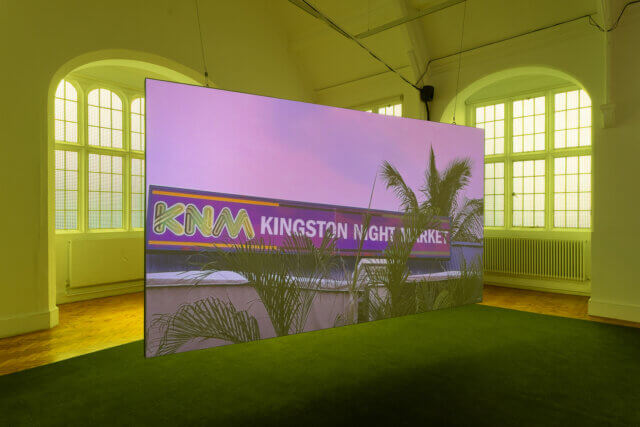
Ain Bailey’s The Jamaica Project leads us into a space of visual, sonic, haptic exploration of all this and more.
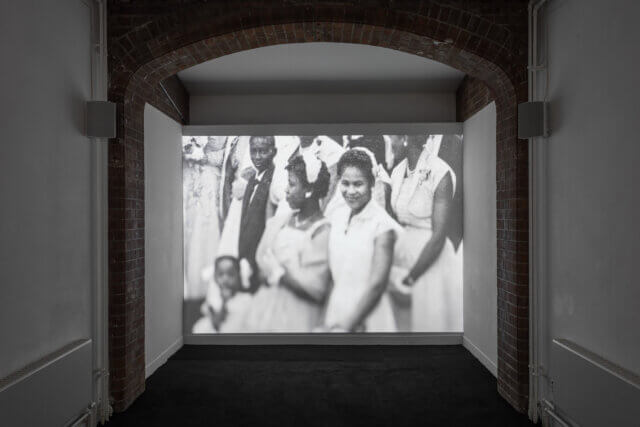
A wedding photo album transmorphs into a video (Untitled: Our Wedding) (2022), where a note, a chord stammers and repeats and opens a portal into an intergenerational discovery and embrace of the felt but unknown worlds that are the sites/scenes of our individual and collective emergence. An ‘unthought known’4 beginning to be given symbolic expression and affective resonance. Souls seeking and haunted, expressed in vibration and echo.
1959
A child. A Black girl. Maybe four or five years old. She looks directly to camera. There seems to be a sadness in her eyes. A sense of slight discomfort. She holds a posy. Perhaps because an adult has instructed her to do this. Perhaps as transitional object 5 – transitional between her and the world. A white headdress crowns her head and accentuates the fact that her parting is not perfectly straight. She is perfect. The vibration in our hearts tells us as the sound hums in drone and note.
2026
The national lurks here but diffracted through the vibration of diasporic imagination that fashions the artefacts brought into communion as The Jamaica Project. This is a national made uncanny. A portal of symbols of ackee, Jamaica’s national fruit – patterning the windows, sculptures hanging from the ceiling, vocalisations of thrill and despair in Elaine Mitchener’s re-coding of Linstead Market. This diasporic practice and sensibility of ackee representation signals both a site of start-from (not security of known origin) and a process of transposition, which work to disrupt any nationalist rendering of the national – any sharp division of here/there: now/then. Stuart Hall told us that diasporic imagination is site and ‘source of desire, memory, myth, search, discovery’6, so the ‘Jamaica’ rendered here is a Jamaica of anterior re-memory that refuses a frozen national as ethno-national ‘homeland’ and invites us into a haptic journey pulsating with quiet feeling and sonic vibration. Here ackee, as symbol of unattainable ‘return’, memory, connection in the ‘diaspora space’7 of London, is also an invocation – a calling-in to touch and feel the emotional and physical labours of a woman as she carries her ackee to market on a Sat’day night in hopes of selling enough to feed her children. But like diaspora itself, this is not one dimensional, and the stutter of ‘Sat’day night’ produces a doubleness in its ‘feel-up, feel-up’, a hint of jump-up and party subtended, up-close and haptically, by a woman’s multiple labours: physical in the picking and carrying and laying and displaying; sonic in the appeal to potential buyers where ‘feel-up, feel-up’ translates into ‘finger and bruise a woman’s fruit’ and maybe her body. Where to carry is the weight of the fruit, the weight of responsibility in conditions of empty belly and empty purse. The weight of dispossession.
1959
Four women. Three look quietly to camera, photographically sounding their own idiom – their way of being in the world. One in a half-turn, with an enigmatic expression. One almost fully face on, eyes commanding attention from the camera, the viewer. Mouth halfway between smile and gritted teeth. Throat and necklace occupying centre-stage. Between these two, a woman faces camera, but her eyes are engaged off-screen – focused to the right on something/someone more immediately meaningful. Top lip slightly curled up to the left. Far right, the fourth woman. Full-face to camera. Left side of her face marking the edge of the photo – as though she marks the border of vision and perception. Full mouth smile, almost an audible laugh. Delight is the felt-sound. Heat is the pulsation, the wave, the quiet sonic that travels between these four women in 1959 and between them and the viewer in 2026. Self-possession the reverberation.
2026
If there is diaspora here, so too time and multi-directional movement; as in disruptions of colonial modernity’s conceptions of time and space; as recastings of inter-relatedness as always containing simultaneous co-existence of ‘everywhens’8 and here and there (or ‘here’ in the ‘there’ and ‘there’ in the ‘here’). It’s effected by Bailey and her co-creators in the ‘inward stretch/outward reach’9, (to riff on Rex Nettleford’s contemplation of the role of artistic creation and cultural forms as foundational to the capacity to reach into self and the world) that these works carry. Embodied in her visual, sonic, affective journey from the wedding album of her parent’s marriage in London in 1959 to her re-memory journey to Jamaica in 2025, as a kind of ‘return’ to the island of her parents’ births. Sixty-seven years crossed and connected that journey and the scenes in Brixton in the long, unusually hot summer of 1959. The year of the racist murder of Kelso Cochrane in Notting Hill in May, ten months after the white, anti-Black riots had scarred the lives and streets of this same Notting Hill signalling the enduring time of anti- Black violence.
In re-presenting the smiling faces, the sound of laughter and joy that hums from Untitled: Our Wedding, Bailey shows that this anti-black time was not the time or space of Black dwelling. Not on this day at least. And ‘this day’ might be this day that you are experiencing The Jamaica Project as much as that day, then. Wedding via Bailey, like Carnival that emerged in response to the anti-Blackness, emerges as expression of Caribbean, Black experience through image and sound and word.
Black Life Living Anyway.
1959
A daughter looks to camera. Sideways. The slightest of smiles graces her lips and eyes. A father, white-gloved hand, holds a lace veil as if holding the tender spot of an infant’s Achilles heel. He holds it in waiting to lift towards the daughter’s slightly smiling face. He stands sideways on, carnation in buttonhole. High cheek bone, edge of lips and brow, side of eye suggest he too offers a gentle, almost shy, smile.
Daughter looks to public. He to her.
Quiet. The quiet of the image vibrates and hums through the screen – passes beneath the skin of the viewer. Calls forth interconnected interiorities of intersubjective becoming. There and then. Here and now.
Textures flow and intensify as the sonic register shifts and accumulates. Pulsates. Tremors. Hums. Ticks.
The eye falls on something exquisite. A button.
Another daughter’s yearning, maybe melancholy (or is it mine? Yours? Ours?) time travels. Life’s quiet interiority 10 is discovered, announced, produced, felt – as much as recorded – in the here and now of the viewing as the then and there of the event.
2026
There is a different temporality pulsating in and through The Jamaica Project. The journeying undertaken from the wedding, advanced in spiral movement to 5 Jacques Road (5C Jacques Road: Part One) (2026), sets us in posterior and anterior time simultaneously as we see that 2025 was already vibrating in 1959, just as 1959 would launch us in search of 2025. A car travels through city and hillside, carrying the ‘everywhens’ captured in the palimpsest inscriptions that are the hoardings screening the space between seashore and road. Motion.
We are moved.
2025
Arrival. Car journey. The travel is toward interiority and return. The electronic echoes and dub of bass signal heart and pulse of re-memory of first-time arrival. Cock crows announce it as both return and first arrival.
Movement between mountains, right, sea, left. Navigation between inscriptions of state-organised life as it collides with life otherwise, configured as cultural form – dance, music, food.
Bells tinkle in gesture of call to attend and gentle welcome.
Joe Gibbs Town Hall! Loudness and hectic vibrations of the clashes of urban life. Vehicular noises, cartwheels on asphalt, pedestrians and bicycles; heavy, sweet fragrances of fruit: banana, guinep, orange, tomato.
The car keeps moving. The journeying still in process, just as the becoming.
Pink, Pink Sky – soars and scratches into sonic view.
1959 – 2025
We move in sonic echo in the reverberations across the sound as the two films speak – nay, vibrate – the entanglement of Brixton and Jamaica. The textures, hard and soft, human and more-than-human, mark the embodiment of this entanglement, not just in what we see and hear but in how this reverberates – through you, me – as viewers-become-participants in the viewing/receiving of these works. Reverberations not in sense of direct repeats but in the ‘felt sounds’ 11 that result from the vibrations emanating from the close-ups of details – a button; a section of lace; a white-gloved hand; a section of cornice; a shoed foot; a glimpsed hoarding or health advisory ad; the suggestion of sex in wedding and an ad for PrEP for HIV; sport layered upon the carceral in ‘Spanish Town Prison Oval: Home of the National Premier League’. The bike rider that passes, the dog alongside, a smile, eye-to-camera/eye-to-eye – that land on the body, invite an ‘embrace of a different understanding of “sound”’12, as portal into the diasporic worlds of Ain Bailey, her co-creatives, and, perhaps, our own, and dwell in the space of diaspora that as Tina Ramnarine 13 tells us is the beingness of multiple attachments and lived homes negotiated through cultural practice.
It is spatial, temporal, psychic journey to be navigated. A way to be found.
2025
Wayfinder. Bike rider and repeated electronic note that rises and echoes converge to guide. Inward and outward wayfinder. Like Nanny and her maroon community, the journey is always-in-process movement towards Black self-possession – the finder signals and starts the way. The rising, repeated electronic note invokes and evokes this maroon haunting before the symphony of bird and insect call startles upon its arrival. There is an unsettling.
Bass line re-enters – regrounds.
Clouded mountainside in shadow and sun. Textures of green and sacking-coloured earth.
Leaves. Dance and twist in concert with wind. White cloud glides across dark grey hilltops and multitextured foliage. Auburn tree trunk exposed by abandonment of leaf, bursts into view.
Leaves. Flowing movement: felt but unseen presence hiding in leaf. Echo of history and time. Refusal and rebellion and makers of freedom.
A daughter re-turns – is touched, sees, sonically inhabits all that is there to be felt – names unknown.
2026
If these are rendered as movement, what of the moments of stillness? The quiet that roars off the image of a face in a Brixton street or a leaf on a Blue Mountain hillside?
2025
Water. Sounds. Drops. Submerged accentuates. Fractures. Gurgles. Resounds. Carries. Pulses. Taps. Gathers. Sounds. Water.
Travels inside head, bounces between eardrums which tremble – gently. Inside summoning those under the water, interred in the earth. Water. Sounds. Stutters. Clings. Grates. Inside upon a land hailed always-already in a London summer of 1959.
Disoriented by beauty and haunting.
Bass line brings relief and orientation again.
Orientation toward a meeting in place and body.
5C Jacques Road: Part One carries memory and trace. And women other than Nanny show their imprint and point the way. Edna Manley via her Negro Aroused sculpture of 1935. Black self-possession again.
And political connection – 15A Jacques Road is now the Amy Jacques Garvey Community Centre. Geography ties. Time connects: 1930s Amy Jacques Garvey lives for a brief time in Fulham in the 1930s, six miles from the place of a Jamaican Brixton wedding in 1959.
Black life in spiral manifestation. End and start just turns on the spiral.
Crosswalks conjuring crossroads.
References
1 Stuart Hall, ‘Cultural Identity and Diaspora’ in Jonathan Rutherford (ed.) Identity,Community, Culture, Difference. (London: Lawrence and Wishart, 1990)
2 Tina Ramnarine, Beautiful Cosmos: Performance and Belonging in the Caribbean Diaspora. (London: Pluto, 2007).
3 Tina M. Campt, Listening to Images. (Durham and London: Duke University Press).
4 Christopher Bollas, The Shadow of the Object: Psychoanalysis of the Unthought Known. (London: Free Association Books, 1996).
5 Donald W. Winnicott, ‘Transitional Objects and Transitional Phenomena’. International Journal of Psycho-Analysis, (Vol.34, Part 2, 1953).
6 Hall, ibid.
7 Avtar Brah, ‘Diaspora, Border and Transnational Identities’ in Cartographies of Diaspora: Contesting Identies. (London: Routledge, 1996).
8 Black Quantum Futurism: Temporal Deprogramming. (London: ICA, 2019).
9 Rex Nettleford, Inward Stretch Outward Reach: A Voice From The Caribbean. (Oxford: Macmillan Caribbean, 1993).
10 Kevin Quashie, The Sovereignty of Quiet: Beyond Resistance in Black Culture. (New Brunswick, NJ: Rutgers University Press, 2012).
11 Campt, ibid.
12 Campt, ibid.
13 Ramnarine, ibid.
Ego Ahaiwe Sowinski (ed.), Ronald Moody: Sculpting Life (London: Thames & Hudson, 2024)
Jason Allen-Paisant, The Possibility of Tenderness: A Jamaican Memoir of Plants and Dreams (London: Penguin Books, 2026)
Raymond Antrobus, The Quiet Ear: An Investigation of Missing Sound: A Memoir (London: Weidenfeld & Nicolson, 2025)
Black Quantum Futurism: Temporal Deprogramming (London: ICA, 2019)
Blank Forms 09: Sound Signatures, (Brooklyn: Blank Forms Editions, 2023)
Christopher Bollas, The Shadow of the Object: Psychoanalysis of the Unthought Known (London: Free Association Books, 1996)
Avtar Brah, ‘Diaspora, Border and Transnational Identities’ in Cartographies of Diaspora: Contesting Identies (London: Routledge, 1996)
Tina Campt, ‘Chapter 5 : Verse Four: The Slow Lives of Still-Moving-Images’ in A Black Gaze: Artists Changing How We See (Cambridge, MIT Press, 2021)
Tina M. Campt, Listening to Images (Durham and London: Duke University Press, 2017)
dove / Chris Kirubi, Wildplassen (London: the87press, 2024)
Remi Graves, coal (London: Monitor Books, 2025)
Will Guidara, Unreasonable Hospitality (London: Ebury Edge, 2024)
Stuart Hall, ‘Cultural Identity and Diaspora’ in Jonathan Rutherford (ed.), Identity, Community, Culture, Difference (London: Lawrence and Wishart, 1990)
Jamaica Kincaid, A Small Place (London: Daunt Books, 1988)
Rex Nettleford, Inward Stretch Outward Reach: A Voice From The Caribbean (Oxford: Macmillan Caribbean, 1993)
Pauline Oliveros, Quantum Listening (London: Ignota, 2022
Kevin Quashie, The Sovereignty of Quiet: Beyond Resistance in Black Culture (New Brunswick, NJ: Rutgers University Press, 2012)
Éliane Radigue, Charles Curtis and Lawrence Kumpf (eds.), Blank Forms 10: Alien Roots: Éliane Radigue (Brooklyn: Blank Forms Editions, 2025)
Tina Ramnarine, Beautiful Cosmos: Performance and Belonging in the Caribbean Diaspora (London: Pluto, 2007)
Gemma Romain, Race, Sexuality and Identity in Britain and Jamaica: The Biography of Patrick Nelson, 1916-1963 (London: Bloomsbury, 2019)
Donald W. Winnicott, ‘Transitional Objects and Transitional Phenomena’, International Journal of Psycho-Analysis (Vol.34, Part 2, 1953)
3 Generations Walking, Midnight Bustling (François Kevorkian Dubs) (Spiritual Life Music, 2003)
Abakush, Crush, Track 1 on Cush / Physically (Juno Records, 2017)
Glass Beams, Mahal, Track 2 on Mahal (Ninja Tune, 2024)
Dennis Brown, Reggae Anthology: Dennis Brown – Crown Prince of Reggae – Singles (1972-1985) (VP Music Group Inc., 2010)
Cornel Campbell, Why Birds Follow Spring aka Wise Birds, Track 4 on United Dreadlocks Vol. 2 (VP Music Group, 2014)
Jack DeJohnette, Epilog, Track 6 on Sorcery (Prestige Records, Inc., 1974)
Eddie Harris, Listen Here, Track 4 on Presenting Eddie Harris (Vee Jay Records, 1961)
Valentina Magaletti and YPY, One Hour Visa, Track 1 on Kansai Bruises (AD 93, 2025)
Billy Paul, Only The Strong Survive – J*Ski Re-Edit, Track 2 on Philadelphia International Records: The Re-Edits (Sony Music Entertainment, 2021)
Eric Prydz, Opus – Four Tet Remix (Virgin Records Ltd, 2015)
Éliane Radigue, Trilogie De La Morte (SACEM, 1994)
Rihanna, Man Down, Track 7 on Loud (The Island Def Jam Music Group, 2010)
John Alexander, Small Island (United Kingdom, 2009),
TV series
Theodoros Bafaloukos, Rockers (Jamaica, 1978), film
Jean-Jacques Beineix, Diva (France, 1981), film
Michelangelo Frammartino, Le Quattro Volte [The Four Times] (Italy, 2010), film
Perry Henzell, The Harder They Come (Jamaica, 1972), film
Juzo Itami, Tampopo (Japan, 1985)
Hong Khaou, Mr Loverman (United Kingdom, 2024), TV series
Menelik Shabazz, Burning an Illusion (United Kingdom, 1981), film
Biography
Ain Bailey (b. 1963, London) is a composer, artist and DJ. She facilitates workshops considering the role of sound in the formation of identity, and the exploration of memory. In 2020 Bailey and Ego Ahaiwe Sowinski created a composition and print entitled Remember To Exhale for Studio Voltaire, London. Previous exhibitions include: And We’ll Always Be A Disco In The Glow Of Love, Cubitt Gallery, London (2019); Version, Wysing Arts Centre, Cambridge (2021); Atlantic Railton which was part of the Listening To The City sound installation programme in the 2021 Serpentine Pavilion; Untitled: Our Wedding for the Black Melancholia exhibition at CCS Bard (2022), New York, USA ;and Trioesque for Bruckenmusik 27 in Cologne, Germany (2022). Bailey’s most recent commission was for FACT Liverpool’s Resolution research project, for which she created the installation Four (2024). She was the 2022-23 Cavendish Arts Science Fellow at Girton College, University of Cambridge. An Art On The Underground commission for Waterloo Station is forthcoming in June 2026.
Credits
Gail Lewis is Black feminist academic, writer and psychoanalytic psychotherapist. She lives in London and is an Arsenal fan.
Shortlisted for the Freelands Award 2023.
With special thanks to our transport partner TFA London.
With gratitude: Wilhel Rubie Laws, Gail Lewis, Elle Reynolds, Luke Flight, Taylor Le Melle, Millie Laws, Susie Laws, Gemma Romain, Remi Stewart, Remi Graves, Dubplates & Mastering, Martha Todd, Matt Ritson, Ree Bradley, Alicia Reyes McNamara, Ego Ahaiwe Sowinski, Jasleen Kaur, Reece Ewing, Anita Bennett, Dashan McLean, Danette the Cook, Ken The Driver, Angela/Jay’s Guest House, Marcia Bogle-Mayne, Claudette Parry Laws, Charlie Prodger, Onyeka Igwe, Nneka Cummins, Djofray Makumbu, Lizzie Graham, Hannah Wallis, Wysing Arts Centre and Nana Adusei-Poku.