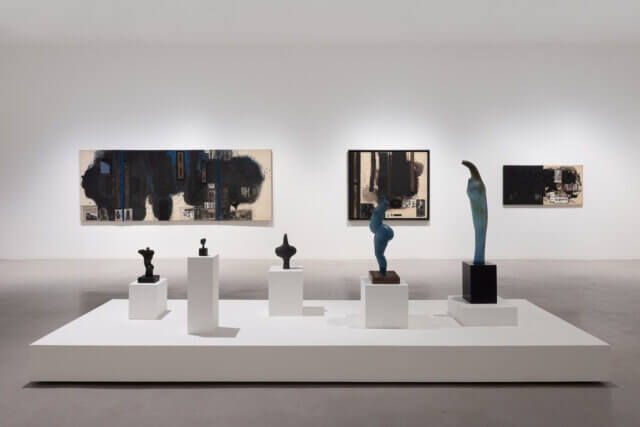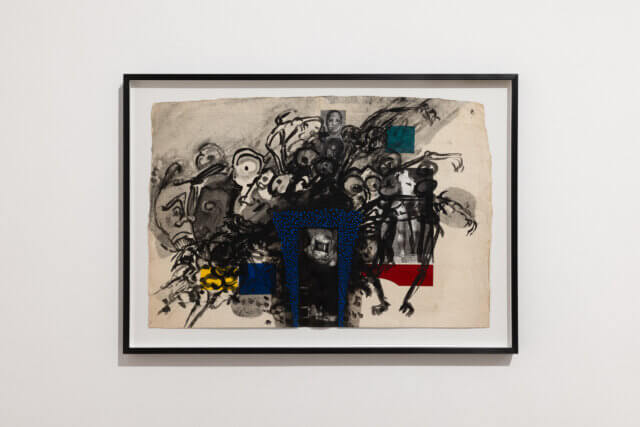
‘Continually moving between two- and three-dimensional modes of expression, all of Locke’s work, on paper, on canvas or in a variety of related sculptural styles, continues to be revelatory. His is an art of constantly renewed vitality and directness. It is reassuring in the way it retains at its core, an innate sophistication, a characteristic that is inextricable from his experience and personality.’ Carl E. Hazlewood
Fecundity of Form
‘The master’s tools will never dismantle the master’s house.’
– Audre Lorde, 1979
Critical engagement with Donald Locke’s work, from the 1970s through to the present, has frequently described his practice as ‘baffling’, ‘complex’ and ‘multifaceted’.1 Eddie Chambers identifies a certain ‘strangeness’ in Locke’s work that evades easy interpretation – a fitting observation for an artist who refused to explain his intentions. In 2008, Locke remarked ‘In the studio … you chase after this particular thing, and these chases, these searches can be described, but what I think the artist cannot do is to explain’, opening his work up to interpretation.2 Of his Trophies of Empire (1972–74), an open cabinet containing cylindrical ceramics, for example, Locke noted ‘The cylindrical shapes are “bullets”, but I have to accept that very few people read them this way.’3 His son, the artist Hew Locke, recently quipped, ‘I mean, come on, they’re phallic objects!’4
Locke Senior cited his diasporic identity as the driving force behind his ‘omnivorous’ absorption of imagery and diverse use of media.5 Born in 1930 in pre-independence Guyana, on a strip of land wedged between two sugarcane plantations, Locke grew up exposed to a system that he later recalled ‘dominated the sky; it dominated your life from beginning to end’.6 Yet the same structures of British colonial rule that shaped this environment also created pathways for mobility, enabling him to travel to England to study – then regarded as the ‘source of all things cultural, political, religious and intellectual’.7 This duality fostered a ‘double-consciousness’ – as articulated by W.E.B. Du Bois in 1903 – through which he could draw upon the formal vocabulary of Western modernism while retaining a critical distance from it.8
In 1954, a British Council scholarship brought Locke, then aged twenty-four, to the Bath Academy of Art in Corsham. This would have contrasted sharply with his earlier experience at the Working People’s Free Art Class in Georgetown, an institution that combined Western artistic training with the cultivation of a national consciousness under the colonial regime in the years leading up to independence.9 In that first trip to Britain, Locke would have encountered the subtle teleological models of progress that cast cultures beyond Western modernism’s orbit as temporally belated and their creative output as therefore derivative. He was aware of African art’s contribution to European modernism and recalls that, when he was at art school in Corsham, it was revered not as fine art but for what Locke – quoting Pablo Picasso – called its ‘raw … primitive power.’10 Locke perceived this as a compliment, but such infantilising framing, which positioned African art as a tool to propel European artists towards modernity, promoted Europe’s avant-garde at the expense of those whose works had been adopted as, in Kobena Mercer’s words, ‘kindling for a burgeoning modernism’. 11 By contrast, Locke looked to the pottery of Ladi Kwali and sculptures of Ife as ‘some of the greatest sculpture in the world’.
Unlike Western modernism’s call for individual authenticity, Locke was expected to produce work that was representative of his cultural identity and not ‘paint like a white person’.12 In 2008, reflecting on his own heritage while living in Atlanta, Locke explained, ‘I am not African. I am a Guyanese in exile’, yet he still felt a connection to his African heritage. As a ‘Guyanese in exile’ he had to navigate this burden of representation – a tension that runs through his work and that may register as the strangeness and complexity that Chambers described.
Corsham’s central tenet, ‘truth to materials’, which was advocated by Henry Moore, demanded that artists should respect the nature of the material they are working with, something Locke worked hard to resist. As he explained, ‘I have to impose an alien will into the process so that steel ceases to be “steel”, marble ceases to be “marble”, bronze ceases to be “bronze” and a new life form is generated.’13 His early work with clay likewise subverted conventional forms, compelling it to behave in unexpected ways. Locke recalled taking the neck of a pot and bending it, thereby denying, in his words, ‘the ceramic object its right to be a vessel’ – an impulse that would later become evident in the Bottle Form works of the 1980s.14 He also experimented with the materiality of objects, combining materials in ways rarely attempted at the time, by overlaying fired clay metallic glazes or lining it with fur, further breaking from the hegemonic ‘primitivist’ script. Such combinations recall the Surrealist transformations of everyday objects found in assemblages like Meret Oppenheim’s Object (1924).
After Locke’s move to America in 1979, he borrowed enthusiastically from other sources. This growing openness to materials and references marked a decisive shift away from the disciplinary boundaries associated with dominant modernist conventions. Speaking in 1978, he declared that ‘I now use any material at hand, and without the old inhibitions which still operate with deadening effect in many of the studios in Britain.’15 He described his use of ceramics, collage, sculpture and painting as ‘journeys into disparate, unconnected styles and modes of artistic expression.’ Yet Locke’s layering of media did more than expand the technical vocabulary of ceramics; it destabilised form itself and set it in motion. Vessels stripped of their functional role could migrate to other symbolic registers – recalling Congolese ritual objects, or Black bricolage, such as those displayed as Trophies of Empire #2 (The Cabinet of Billy Mick Miller [The Altar Piece of Hernando Cortez]) (2006–08), or assume gendered identities, as in Pair of ‘Male and Female’ Vessels (1976) – remaining open to reinvention and suggesting a fecundity of form.
Pomona – the Roman goddess of fruitful abundance – appears as a recurring figure across different media throughout Locke’s career. The bronze figurine Pomona Blue (1985–86) recalls the fragmentary condition of surviving classical statuary, and reappears in the sprawling canvas Dynasty, The Birth of Empire (The Birth of Empire #2) (1989), and as photocopied imagery in Pomona (1990), later contorted in Georgia Peach #2 (1993), to give only a few examples. Locke’s ongoing engagement with Pomona demonstrates a Surrealist tendency to manifest the unconscious mind. In Pomona he links the fecund curves of his pregnant neighbour Ruby that had imprinted on his ten-year-old mind, with the famed, rotund buttocks of the so-called ‘Hottentot Venus’, Sarah Baartman – a South African Khoikhoi woman who had been exploited as a freakshow exhibit and toured through Europe in the 1800s. Locke had sketched Baartman’s remains when they had been on display at the Musée de l’Homme in Paris in 1955. When the figure of Pomona resurfaces in a painting such as The Cage (1990), this later reading of exploitation comes to the fore. In all instances, Locke allows these long-gestating sources to find new form.
The generative instability that marked Locke’s treatment of materials also shaped his engagement with dominant modernist conventions, most clearly in The Plantation Series (1972–76). The series of sculptures – modular constructions containing ceramic and ready-made elements that evoke the language of Constructivism and Minimalism – emerged, perhaps significantly, soon after Locke’s arrival in London. As art historian Giulia Smith has cogently argued, Locke crammed life into his grids at the same moment that Rosalind Krauss argued that grids are ‘what art looks like when it turns its back on the world’.16 Where Minimalism deflected meaning onto the space of a work’s presentation, Locke redirected meaning back into his grid structures, encoding them with Guyanese specificities. Here, the grid becomes a carceral frame, containing sugar cane and humanlike figures within a geometry that echoes the spatial logic of the plantation itself.
Similarly, Locke’s experiments with Land Art, which he preferred to call ‘land interventions’, inverted the movement’s objectives. For example, in The Journey (1973), he staged and photographed his ceramic bullet sculptures in Britain, France and Spain. After his move to Arizona in 1979, he staged Arizona Squares (1979–81) which comprised a series of black paintings arranged in the desert. Both works recall Robert Smithson’s Yucatán Mirror Displacements (1–9) project of 1969, in which mirrors were placed within the landscape to fragment and destabilise the viewer’s perception of space. Yet Locke’s engagement was quite different, using the landscape as a conceptual stage, rather than as raw material.
The long view of Locke’s career reveals a unifying thread across these seemingly disparate modes of expression: strategies of fugitivity that continually give orthodoxy and expectation the slip. In this respect, he is in good company, belonging to a lineage of West African, African Caribbean and Caribbean artists such as Oku Ampofo, Sybil Atteck, Sam Ntiro and Aina Onabolu who, since the first decades of the twentieth century, employed strategies of resistance in their work to navigate the discursive horizons within which they operated and established the institutional frameworks for the next generation of artists in their respective countries. Locke actively flattened out the entrenched art-historical hierarchies of genre and media that had been instilled within the academy since the seventeenth century, collapsing traditional distinctions between painting, sculpture and ceramics into a more fluid field of artistic production.
Clearly, Locke’s engagements with modernist styles may be seen to be inflected by his experience in Guyana. But to frame them in this way risks casting his career as merely reactive, rather than recognising the generative role he played in reshaping these artistic languages. Smith has taken this idea further, recognising that Locke was offering a model for thinking about modernism with Guyana at its centre. No longer positioned as belated, Locke’s oeuvre reveals colonialism not as modernity’s shadow, but as one of its driving forces.
References
1 For example, Vicky Hay, ‘The Multifaceted Donald Locke’, American Visions, October 1989; Holland Cotter, ‘Bending the Grid’, The New York Times, 25 June 2004, B27; David Trigg, Studio International, 18/06/2025.
2 Eddie Chambers, ‘The Uncontainability of Donald Locke’, in Donald Locke Resistant Forms (London/Birmingham: Spike Island, IKON and Camden Art Centre, 2025). And Donald Locke in ‘Master Works / Recent Works’, Gallery Talk (film) (New York: Skoto Gallery, 2008).
3 Letter from the artist to Tate curator Andreas Leventis, 13 December 2009. https://www.tate.org.uk/art/artworks/locke-trophies-of-empire-t14319.
4 Hew Locke and Robert Leckie in conversation, IKON, Birmingham, 12 November 2025.
5 Quoted in Brenda Locke and Robert Leckie, ‘In Conversation’, in the Donald Locke Resistant Forms exhibition guide, 2025.
6 Hay, ibid.
7 Donald Locke, material for Paul Rice, London, England, April 2007. Walmsley Donald Locke Correspondence and Papers. TGA 201512/1/1 Tate Gallery Archive, London.
8 Locke’s sense of ‘double-consciousness’ is discussed in Giulia Smith ‘Donald Locke’s Black Vitalism’, and Locke’s living near plantations is referenced in the Chronology in Donald Locke Resistant Forms.
9 The Working People’s Free Art Class drew the attention of the British authorities, who feared it was a front for a communist organisation. One of the detectives sent to infiltrate WPAC classes developed an interest in art and exhibited work through them.
10 Donald Locke in ‘Master Works / Recent Works’.
11 Letter from Alain Locke to Arthur Schomburg, 12 October 1928. Alain Locke Papers 164-83-33. Manuscript
Division. Moorland-Spingarn Research Center, Howard University, Washington D.C.
12 Donald Locke in ‘Master Works / Recent Works’.
13 Donald Locke, ‘Artists Among Us’, Contemporary Forum Newsletter (Spring) 1989.
14 Donald Locke in ‘Master Works / Recent Works’.
15 Rasheed Araeen, ‘Recovering Cultural Metaphors’, The Other Story: Afro-Asian Artists in Post-War Britain. Southbank Centre, 1989.
16 Giulia Smith ‘Donald Locke’s Black Vitalism’, in Donald Locke Resistant Forms.
Samuel Taylor Coleridge, ‘The Rime of the Ancient Mariner’ in Lyrical Ballads, with a Few Other Poems (London: J. and A. Arch, 1798)
David Dabydeen (ed.), Martin Carter Selected Poems / Poesías Escogidas (Leeds: Peepal Tree Press Ltd, 1999)
Henry Miller, Black Spring (Paris: Obelisk Press, 1936)
Robert M. Pirsig, Zen and the Art of Motorcycle Maintenance (New York: William Morrow and Company, 1974)
Georges Bizet, Les pêcheurs de perles [The Pearl Fishers] (EMI Records Ltd, 1978)
Gaetano Donizetti, Lucia di Lammermoor (Decca Music Group Limited, 2009)
Miriam Makeba
Luciano Pavarotti
Jean Sibelius
Mighty Sparrow
The Atlanta Braves baseball team
Luis Buñuel, Le Charme Discret de la Bourgeoisie [The Discreet Charm of the Bourgeoisie] (France, 1972) film
Paul Cézanne
Werner Herzog, Fitzcarraldo (West Germany, 1982) film
Akira Kurosawa, Ran (Japan, 1985) film
Akira Kurosawa, Seven Samurai (Japan, 1954) film
Monty Python
Quentin Tarantino, Pulp Fiction (United States, 1994) film
Biography
Donald Locke (b.1930, Stewartville, Guyana; d. 2010 Atlanta, USA) was a Guyanese painter, sculptor, and ceramicist, whose career was marked by its ambitious, interdisciplinary nature.
He grew up in Guyana and attended the Working People’s Art Class (WPAC) taught in Georgetown by Guyanese artist Edward Rupert Burrowes in 1947. He was awarded scholarships to study at Bath Academy of Art at Corsham from 1954–57 and Edinburgh School of Art from 1959–64, where he obtained an MA in Fine Art. Locke returned to Guyana in 1964 to become Art Master at Queen’s College in Georgetown, where he taught until 1969. He then received a bursary to return to Edinburgh School of Art to study ceramics, after which he moved to London, where he lived from 1970–78. In 1979, Locke was awarded a Guggenheim Fellowship in Sculpture at Arizona State University. He lived in Phoenix, Arizona until 1990 and then moved to Atlanta, Georgia, where he lived until his death in 2010.
Prior UK solo exhibitions include: Pork Knocker Dreams, Nottingham Art Exchange and Wolverhampton Art Gallery (2009-2010) curated by Indra Khanna; and Commonwealth Institute, London (1975). Other solo exhibitions include: Atlanta Contemporary Art Center (2024–25); High Museum of Art, Atlanta (2016–17); Aljira, a Center for Contemporary Art, Newark (2004); and City Hall Gallery East, Atlanta (2003). Group exhibitions include: Black Atlantic: People, Power, Resistance, The Fitzwilliam Museum, Cambridge (2023); Life Between Islands, Tate Britain, London (2021) and Art Gallery of Ontario (2023); Back to Black: Art, Cinema and the Racial Imaginary, Whitechapel Gallery, London (2005); The Other Story, Hayward Gallery, London (1989); FESTAC ‘77, Lagos (1977); and the 12th São Paulo Biennial (1971). Locke’s works have been acquired by institutions including Victoria and Albert Museum, London; Fitzwilliam Museum, Cambridge; Smithsonian Institute, Washington DC; Studio Museum in Harlem, New York; Virginia Fine Art Museum, Virginia; and High Museum of Art, Atlanta.
Credits
Hattie Spires is a curator and writer based in London. Her recent doctoral research traces Harlem Renaissance discourse through lines of resistance to British colonialism.
Donald Locke, Resistant Forms is organised by Spike Island, Bristol; Ikon Gallery, Birmingham; and Camden Art Centre, London; with support from the Donald Locke Estate. The exhibitions at Spike Island and Ikon Gallery were curated by Robert Leckie, Director of Gasworks, London (and former Director of Spike Island). The exhibition at Camden Art Centre is curated by Martin Clark and Gina Buenfeld-Murley, in collaboration with Robert Leckie.
Resistant Forms is generously supported by Alison Jacques, the Ampersand Foundation, the Estate of Donald Locke, Henry Moore Foundation and Paul Mellon Centre for Studies in British Art.
The exhibition at Camden Art Centre has generously been supported by Cockayne Grants for the Arts, a Donor Advised Fund, held at the Prism Charitable Trust.
With special thanks to our transport partner TFA London.