‘Non si guarisce o aggiusta nulla||
si frantuma e si riconsegna.’
‘Nothing is healed or fixed||
it is shattered and given back.’ – Franca Mancinelli
(a) Welcome all those who have travelled in the mental and physical and (let’s say) spiritual or emotional realms, those whose travels are propelled by the secret engine motivating us…All are Welcome.
(b) You have arrived into a fictional realm. Please accept a brief guide to this beautiful and impossible place.
(c) ‘The secret engine motivating us’ is a phrase borrowed from the artist Liz Larner, who has brilliantly created and made possible this impossible place.
(d) In this brief guide, terms and definitions are mostly defined. Just occasionally, they are undefined.
(e) Exceptions may prove the rule. (But also, there may be exceptions to this rule that exceptions prove the rule.)
(f) Also, a few words about words. Often we try to capture words, fix them to a single meaning, confine them in dictionaries. But this place is more suited to the pliable poetry of the thesaurus, wherein each word has many equivalents, presenting different cadences of meaning. Larner is a formalist who works with formlessness; a crucial paradox. (see d, definitions)
(g) Here, you must go your own way … Linger, hasten, walk, pause for a short or long time, run (no, no maybe don’t run, or not so fast you fling your fellow gallery-goers to the floor) but move backwards, forwards, onwards, inwards – so long as you go your own way.
(h) Let’s begin at the beginning, or even further back in time. Before time, way back when there was no ‘when’ at all, just formlessness, a great chasm. The poet Hesiod describes this chasm as a dire place, afflicted by storm winds, terrible even to the gods. Out of the formless chasm comes Nyx or Mother Night. Then, from Night comes Day. In the House of Nyx, both Day and Night reside, but never at the same time: one leaves, the other returns. In the Orphic tradition, Nyx lays the cosmic silver egg, from which emerges the winged god Phanes (also Protogonos or firstborn). We find Nyx here among Larner’s asteroid series – a shining cosmic egg, evoking the known and unknown, the formless chasm, day and night.
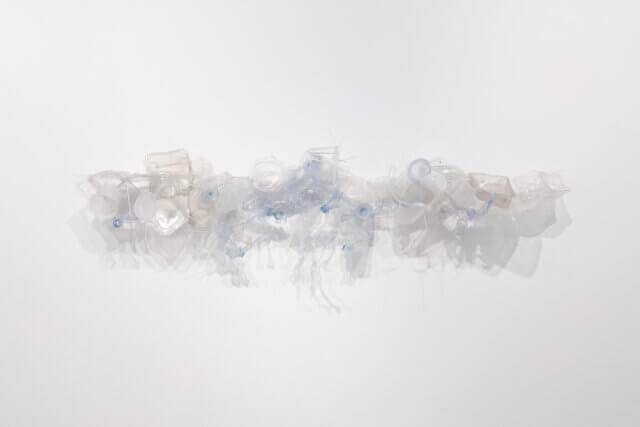
(i) Here the stars and seas entwine, the asteroids interrupt the seafoam. Or the seafoam interrupts the asteroids. Larner’s plastic sculptures are ambiguous – implying both hardness and softness, beauty and danger. In black iris, delicate forms resemble the petals of a flower or the dark twisted forms of an ocean by Night. In hard bubble, rigid plastic appears watery, delicate and almost invisible.
(j) The asteroids are named after venerable and ambiguous gods, balancing aspects of time and space. Psyche – goddess of the inner mind or soul. Pallas (Athena) – goddess of war and wisdom. Osiris – both fertility god and god of the underworld, weighing the hearts of the dead in the Hall of Judgement. Ida – named after the Dactyls of Mount Ida, ancient magical beings associated with the Mesopotamian goddess Cybele, inventor of metalwork and magic. In some of the myths the Dactyls work for Hephaestus, teaching the first letters of the alphabet to humans.
(k) In works such as More than nothing left behind, Larner makes use of the Japanese technique of kintsugi – ‘joining with gold’ or ‘golden repair’. Supposed flaws are beautified, the history of an object is revealed in delicate patterns, foregrounding ideas of transience and time…
(l) Here, we also find Lilith: ancient being, bird, spirit, demoness and rebel. Her sin was refusal. There are all kinds of judgements. Perhaps it’s all a terrible misunderstanding. The name echoes in the earliest forms of writing, in Gilgamesh and the Huluppu-Tree, a Sumerian epic from c. 2000 BCE, where lilītu are female demons or wind spirits. Later, Lilith is accused of the worst crimes. Demoness, rebellious wife, consort of Satan. Perhaps she doesn’t mind. She’s ancient beyond knowledge, beyond words. Perhaps such forms barely resonate in the formless realm.
(m) One Lilith piece is titled A hard line to bend. (She is also evoked in a ceramic piece, as Lil’). A hard line to bend is formed from a branch of a madrone, a wonderful tree that grows beside the ocean. It is a hard wood, a hard line to bend. It is hard to bend lines, to bend form, to forge new forms from old. It is hard to bend words, to change their meanings, when they tend to fixity and hardness. Yet, in this work, hard forms are forced to bend and re-enchanted. The sculpture is mysterious and dynamic. As well as the madrone there are cedar sprays, which resemble feathers. There is a bronze hand and an owl’s leg. Lilith is a hybrid being, reminding us of the earth, and the sky, and the ocean.
(n) The Latin term for madrone is Arbutus menziesii. This refers to the Scottish botanist Archibald Menzies. His family home was in Aberfeldy, Perthshire, and was named Styx. What a name for a home! Styx is a horrifying river through the underworld, but also an ancient goddess, one more traduced feminine deity perhaps. Nyx, by the way, was the mother of Styx. Yet there’s another possible meaning. The house name Styx might have emerged from a Gaelic word, Stùc, referring to a steep hill or horn-shaped mountain and sometimes used poetically to suggest implacable nature. So words change across time, will not stay in place…
(o) Another piece, In all her syntagma she loveth not to go on common paths, is made of ceramic, brass and reflective coloured glass. ‘Syntagma’ means the process by which units, elements, combine into an orderly system. It comes from the Ancient Greek ‘syn’ (together) and ‘tassein’ (to arrange or order.) The word is linked to ‘syntax’ – meaning the arrangement of words into orderly sentences. In all her syntagma she loveth not to go on common paths presents reflective surfaces that invert the work and reorder the surrounding space. Viewers come and go, casting different reflections; the order of elements becomes mutable and unknown.
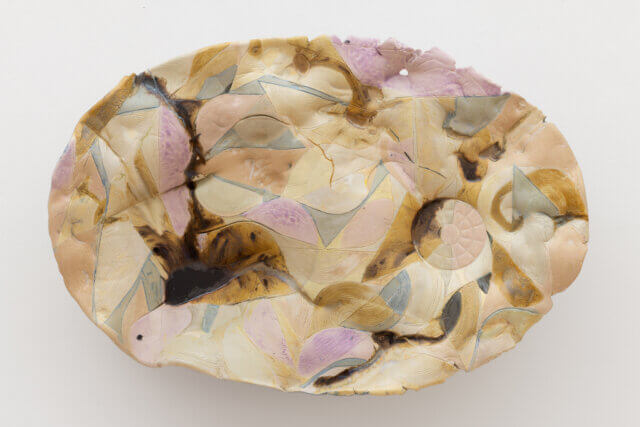
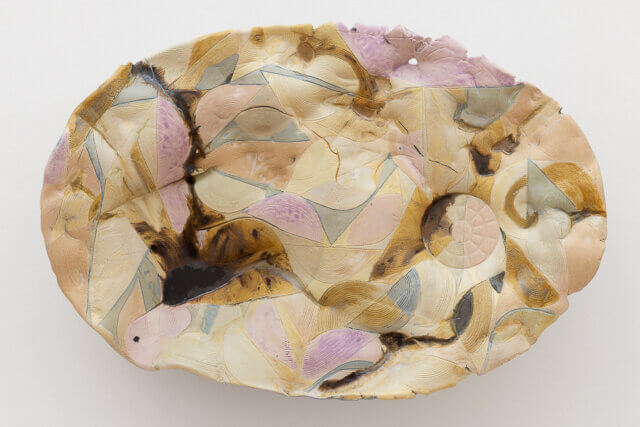
(p) The word ‘ceramics’ derives from the Greek keramos, ‘burnt earth’. It describes both a material and a process in which protean clay is fired and fixed. For works such as ii (mantle), Marthe and xvii (caesura), unfired ceramic slabs are laid over an unknown form, then coated with coloured epoxy. The process of firing and glazing leads to unforeseen consequences, ruptures, fissures or so-called imperfections in the surface. Instead of planning rigidly, Larner allows the material to go its own way …
(q) These works pose fascinating questions about form, colour and texture, about scale, microcosm and macrocosm. In i (calefaction), raw stones and minerals are embedded in the clay before the firing process. Do these forms represent constellations, or islands in the ocean, or land masses seen from space? Marthe refers to one of Pierre Bonnard’s portraits of his wife, Grand nu à la Baignoire (1924), and asks further questions about form and meaning. Is Marthe evoked by shape, by name, by bright pigments? Meanwhile, xvii (caesura) refers to a literary term – ‘caesura’ – meaning a rhythmic pause that splits a line of poetry into two halves. A caesura may balance opposing ideas, or stage a paradox. Or, it may enforce a dramatic pause, adding emphasis: ‘To be or not to be – that is the question.’
(r) Larner found the word ‘syntagma’ in Roget’s Thesaurus. At the time she was looking for an altogether different word (‘warlock’). Larner often works with a thesaurus. Another sculpture is titled MacGuffin is not in the thesaurus. A ‘MacGuffin’ is a plot device that moves a narrative along, but its identity may never be revealed. It is a spur or stimulus, like the unknown forms on which Larner spreads the clay before it is fired.
(s) Onto the smiles. Two sculptures, made of porcelain: smile (fangs) and smile (abiding). A smile almost always has a modifier. An unbridled smile, a polite smile, a reluctant smile, an awkward smile, a friendly smile, a villainous smile, a sinister smile, a self-satisfied smile, a languid smile. Smile with fangs. An abiding smile. For William Blake, smiles are modified by way of contraries: ‘There is a Smile of Love/And there is a Smile of Deceit/And there is a Smile of Smiles/In which these two Smiles meet.’ Slightly more hopeful, Virginia Woolf describes ‘the most exquisite smile, veiled by memory, tinged by dreams.’
(t) Smiles are a transient expression. They come and go, they flicker, flash or break. A sculpted smile, rendered in porcelain, is an eerie proposition. Once more, Larner questions ideas of fixity and hardness. Her smiles stand upon large black cases that could easily contain them.
(u) In Larner’s work, across several decades, she has returned to themes of the uncanny, the unexplored, the unfamiliar. Her witty, paradoxical sculptures explore the gap between form and formlessness; a cosmic caesura, in a sense. On one side there is the world of forms. On the other, the otherworld in which such forms dissolve …
(v) Another plastic sculpture, veiled pother, draws on another mesmerising paradox. A ‘pother’ is a state of turmoil or confusion. In Roget’s Thesaurus synonyms include: fret, dither, lather, stew, commotion, furore, turmoil, disturbance, hubbub, rumpus and ado. Antonyms include: calm, quiet, peace. Larner’s ‘pother’ is ‘veiled’, suggesting a state that is neither absolute turmoil nor absolute calm, but somehow both.
(w) Nothing here is adamantine. Nyx balances Day and Night. Osiris balances life and death. Psyche wanders in mind, through inner and outer space. Earth and sky mingle, asteroids and seafoam. Apparent opposites are weighed, and balanced: hard/soft, turmoil/calm, form/formlessness.
(x) Also: here/not here. Larner’s X sculptures (not here) also work with gaps and paradoxes. X is a mathematical variable, a defined form that represents the undefined. In the case of a sculpture, it is a tangible form that represents the intangible. Some of Larner’s X’s are large public works, such as a mirror-polished stainless-steel X with curved legs, erected in Minneapolis in 2016 and resembling a beautiful shining quadruped. Others such as Variable (1990) are smaller pieces, in painted bronze. For Larner, X is ‘illimitable’.
(y) In our uneasy Digital Age, where randomness is ostensibly erased by a vast architecture of predictive algorithms, we are nudged onto common paths. All variables must be defined, including those that can’t actually be defined at all. This causes some trouble with reality. Larner’s exquisite sculptures hint towards the formless, the unforeseen, towards ancient darkness and deep time. Lines, hard lines, hard forms, ossified notions are bent and forced to yield.
(z) Thanks to Shakespeare, there’s no need for Zebra, Zigzag or Zither – all good words anyway. In King Lear, one character dismisses another as merely a ‘Zed’ – an ‘unnecessary letter!’ The letter ‘Z’ was once considered redundant, because it could be replaced. This doleful verdict might apply to countless forms of beauty, joy, mystery, myth, empathy and delight. Not zo! Larner works with a dizzying array of forms, materials, unforeseen elements. She is an extraordinary proponent of the impossible, the unknown, the illimitable.
Here ends this brief guide to an impossible place. Now, go your own way, along uncommon paths, and try to bend the lines (as much as possible, or further still).
Elements, materials
Acrylic paint
Aluminium
Brass
Cedar sprays
Ceramic
Enamel paint
Epoxy
Fibre board
Glass, coloured
Glaze
Kintsugi
Lace
Lead shot
Human hair
Madrone
Measuring tapes
Minerals
Mulberry tissue
Muntz brass
Oil paint
Pigment
Plastic
Porcelain
Ribbon
Rope
Rubber
Stainless steel
Stones
TV antennae
Wire
Other terms (some of which are not in the thesaurus)
Absence of form: formless, unformed, chaotic, vague, nebulous, embryonic, unhewn, structureless, barely there, illimitable, hard to discern unless you screw up your eyes and really really look, indistinct, inchoate, shadowy, undefined …
Form: shape, configure, cast, mould, fashion, turn, pattern, structure, chisel, hew, hammer out, trim, compile, assemble, sculpt, stamp, create, make, carve, work up, verbalise, set, figure, sketch, draft, draw, forge, mint, express, fix, formalise, capture, contain, finally find a way to realise that maddening inchoate notion that has been perplexing you for years, give shape to something formerly indistinct…
Intellect: inchoate apperceptions, mind, psyche, brains, understanding, comprehension, thought, wisdom, wits, nous, reason, vague notions, germ of an idea, some kind of sense of what on earth, judgement, formulation of notions, speaking too fast while waving hands around, generous communication of ideas …
Motivations: incentive, stimulus, drive, incitement, spur, goad, rationale, initiative, enterprise, sense of purpose, the secret engine motivating us …
Space: expanse, volume, scope, lati tude, area, opening, aperture, gulf, cranny, fissure, rift, crack, breach, break, split, flaw, crevasse, interstice, lacuna, blank, caesura, dark mythical chasm filled with storm winds, the possibly infinite or finite universe, a smaller or greater gap, variables, room to create …
‘The puzzle reveals that when we’re presented with formlessness, we try to impose form. We box in the dots in one way or another. We apply a structure. Also we need some forms, of course, otherwise we’d be floundering in formlessness. It’s a question of somehow doing both: inhabiting the world of forms, as we must, and also inhabiting the otherworld, in which such forms dissolve.’ Johanna Kavenna
References
Blackhawk, Ned. The Rediscovery of America: Native Peoples and the Unmaking of U.S. History. New Haven: Yale University Press, 2023
Braidotti, Rosi & Maria Hlavajova, eds. Posthuman Glossary. London: Bloomsbury Academic, 2018
Braidotti, Rosi. Posthuman Knowledge. Cambridge: Polity Press, 2019
Braidotti, Rosi. Posthuman Feminism. Cambridge: Polity Press, 2022
Carrington, Leonora. The Hearing Trumpet. Cambridge: Exact Change, 1996
Butler, Octavia E. Lilith’s Brood, originally published as the Xenogenesis Trilogy. New York: Grand Central Publishing, 2000
Harvey, Graham, ed. The Handbook of Contemporary Animism. London: Routledge, 2014
Harvey, Graham. Animism Respecting the Living World. London: C. Hurst & Co., 2017
Kavenna, Joanna. The Ice Museum. New York: Viking Penguin, 2006
Kavenna, Joanna. The Birth of Love. New York: Henry Holt and Company, 2010
Kavenna, Joanna. Seven. London: Faber & Faber, 2026
Macy, Joanna. World as Lover, World as Self: Courage for Global Justice and Planetary Renewal. Berkeley: Parallax Press, 2021
Natural Numbers. ‘(What’s So Funny ‘Bout) Peace Love and Understanding [feat. Judah Eskender Tafari],’ Track 2 on Listen to the Lion (Dub Club LA, 2020)
Ellington, Duke. ‘Montevideo,’ Track 14 on Piano Reflections (Capitol, 1953)
Monk, Thelonious. ‘Ask Me Now,’ Track 11 on Solo Monk (Columbia Records, 1964)
Ólafsson, Víkingur and Jean-Phillppe Rameau. ‘The Arts and The Hours,’ Track 1 on Debussy – Rameau (Deutsche Grammophon GmbH, Berlin, 2020).
Simone, Nina. ‘Good Bait,’ Track 7 on Little Girl Blue (Bethlehem Records, 1959)
Antonioni, Michelangelo, dir. Red Desert [Il deserto rosso] (Italy, France, 1964), film
Credits
Joanna Kavenna is an award winning novelist and essayist. Her books include A Field Guide To Reality, ZED and – most recently – Seven.
This exhibition was made possible through the generous support of:
Headline Supporter
Alex Hank
With
Anton Kern Gallery
Galerie Max Hetzler
Regen Projects
The Modern Institute
The Liz Larner Exhibition Circle
Lee Broughton and Chrissy Taylor
Karen Hillenburg
Camden Art Centre Artists’ Circle
And those who wish to remain anonymous.
With special thanks to our transport partner TFA London.